

 Christianity Protestant
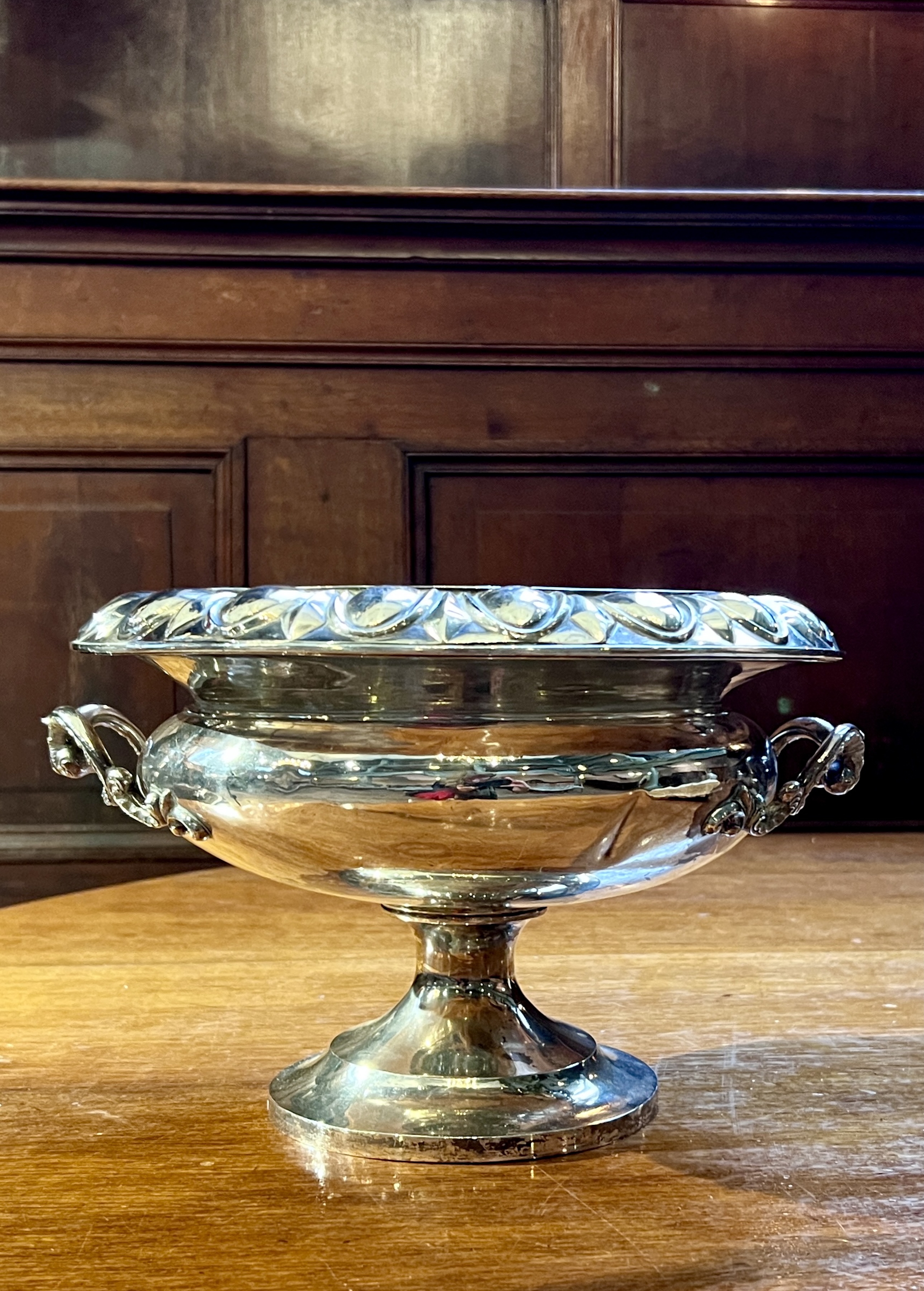
In this sober Mennonite hidden church, adult baptisms have been taking place for more than 400 years. At present, this silver-plated nineteenth-century baptismal bowl is used for the baptismal services.
Location
Kerk bij ’t Lam (Singelkerk)
Singel 452
Type
Hidden church
Religious community
Verenigde Doopsgezinde Gemeente
Object
Silver-plated bowl used for baptisms
Maker and date
Dickhoff & Salm
1863
Visit
On display during Sunday services
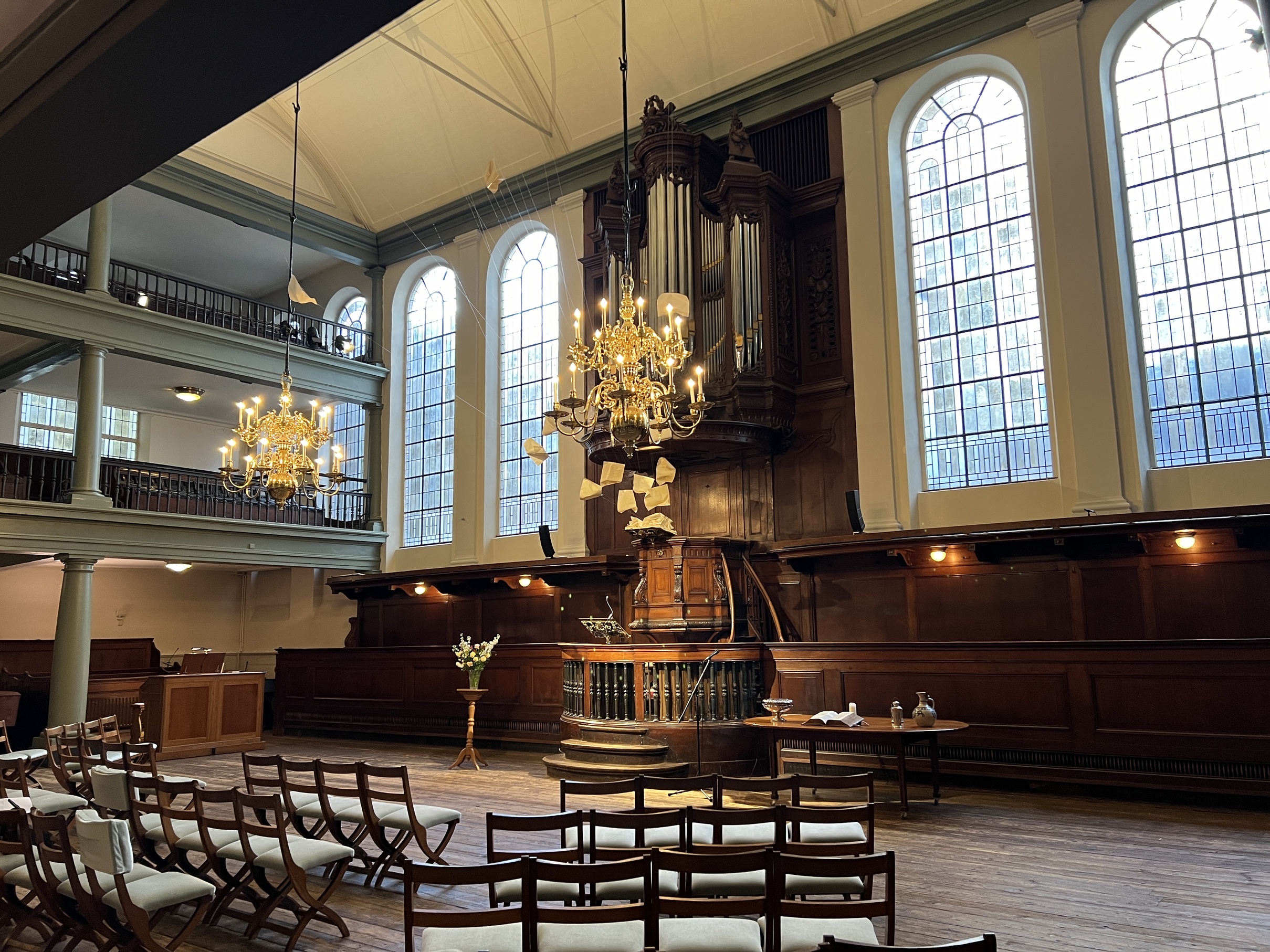
Current interior
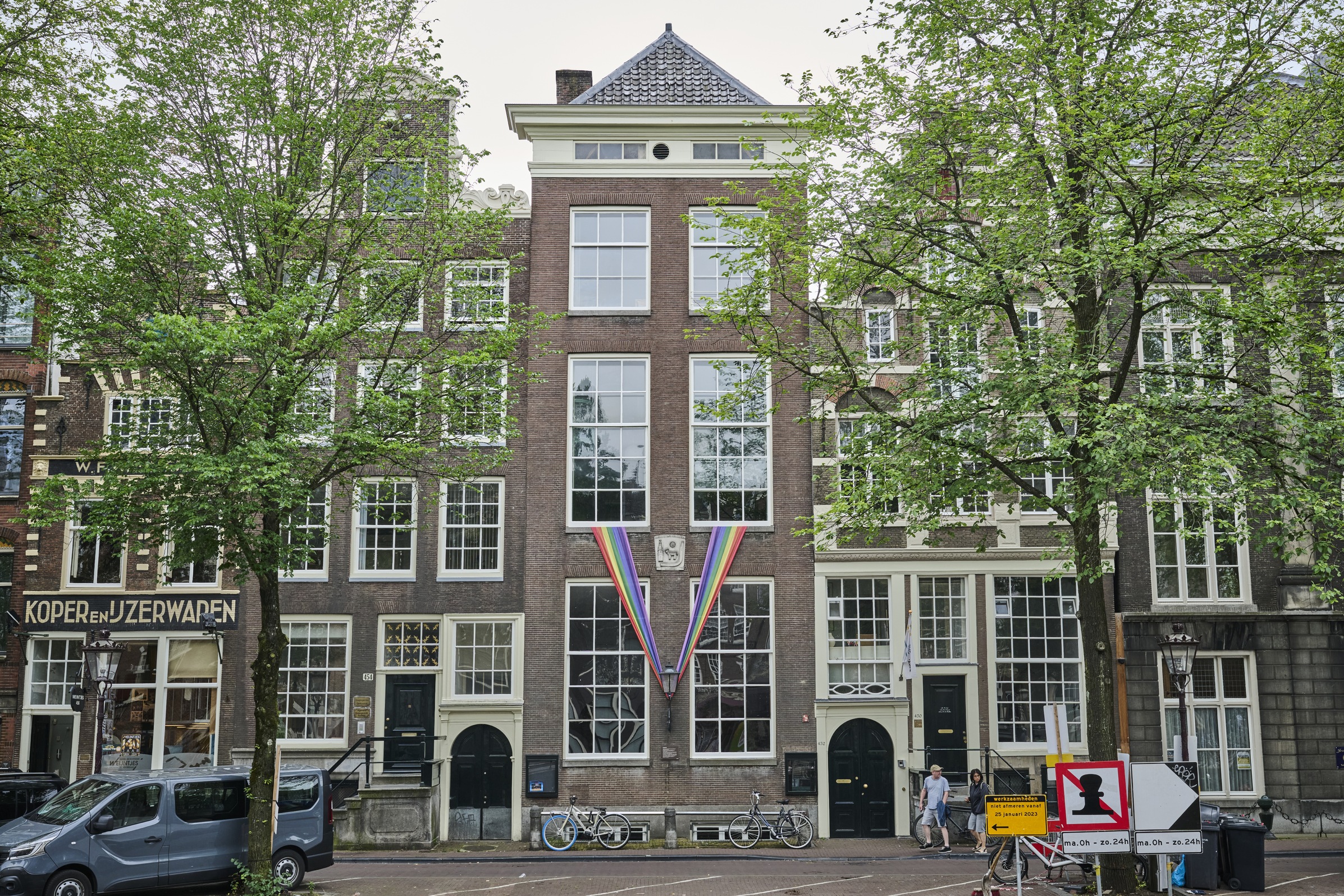
Current exterior
Adult Baptism Then and Now
This vermaning, which dates to the early 1600s, was built on land purchased by the merchant Harmen Hendricksz. van Warendorp. Known as the Kerk bij ’t Lam due to its location next to a brewery with a lamb in the gable stone, it was originally the gathering place of the Flemish group of Mennonites, though other Mennonite subgroups united with them and departed from them over the years (see Lammerenkrijgh). For Mennonites, adult baptism is an important milestone and celebration in church life. At the Singelkerk, the vessel that is currently used to hold the water for baptismal services is a nineteenth-century silver-plated baptismal bowl made by the Dutch company Dickhof & Salm, which bears the inscription ‘22 november 1863’.
Vermaning
Dutch Mennonites have historically called their churches vermaningen [roughly translated, ‘admonitions’]. This stems from the Mennonite understanding of the congregation as church: congregants were to discern scripture together, and to try and hold each other accountable in their faith and daily lives.
Adult baptism (Mennonites)
Baptism is understood by Mennonites as a symbolic outward sign of an inner commitment. It also generally marks the baptismal candidate’s full entrance into church membership. Candidates participate in a discussion group, then there is a “belijdenisavond” [“confession of faith evening”] in which they share their beliefs and reasons for choosing baptism with members of the congregation. Baptism follows during a Sunday service shortly thereafter. Around the world, Mennonites conduct adult baptism by sprinkling, pouring, or full-body immersion in water.
Dutch Mennonite/Doopsgezind subgroups
There were many different branches of Dutch Mennonites in the early modern period, including Old and Young Flemish, Old and Young Frisians, High Germans, Waterlanders, and other splinter groups. Mergers also occurred (eg., the Flemish, Frisians, High Germans, and later also Waterlanders, united with the Flemish at the Kerk bij ’t Lam). As of the 1660s, groups also redivided themselves as Lamists or Zonists (see Lammerenkrijgh). Nearly all groups reunited in Amsterdam in 1801, and nationally in 1811, forming the Algemene Doopsgezinde Sociëteit (ADS).
Dutch Mennonite Nomenclature (Anabaptist/Mennonite/Doopsgezind)
The conservative groups preferred to be called Mennonites [“Mennonieten”] after Menno Simons, while more progressive groups called themselves Doopsgezinden [“Baptism-community” or “Baptism-minded”], following in the footsteps of the Waterlanders who chose this name for themselves in the 1550s. At present, all Dutch Mennonites go by “Doopsgezind,” while the term “Mennonite” is used to refer to the denomination internationally. The name “Anabaptist” is used as the umbrella term to refer collectively to the Mennonites, Amish, Hutterites, and Brethren in Christ (all denominations which emerged from the so-called “Radical Reformation”).
Lammerenkrijgh [War of the Lambs]
A conflict regarding confessions of faith led to a schism in the Kerk bij’t Lam in 1664. The minister and Collegiant thinker Galenus Abrahamsz. de Haan, and his followers, believed that confessions of faith should be seen as guiding documents that evolve with congregational life. Samuel Apostool, and his followers, felt these were binding documents. Followers of Galenus remained in place, while followers of Apostool left and established a new hidden church called the Zon at warehouse down the street. Most Mennonite groups around the Republic followed suit in affiliating with either the Lamists or Zonists.
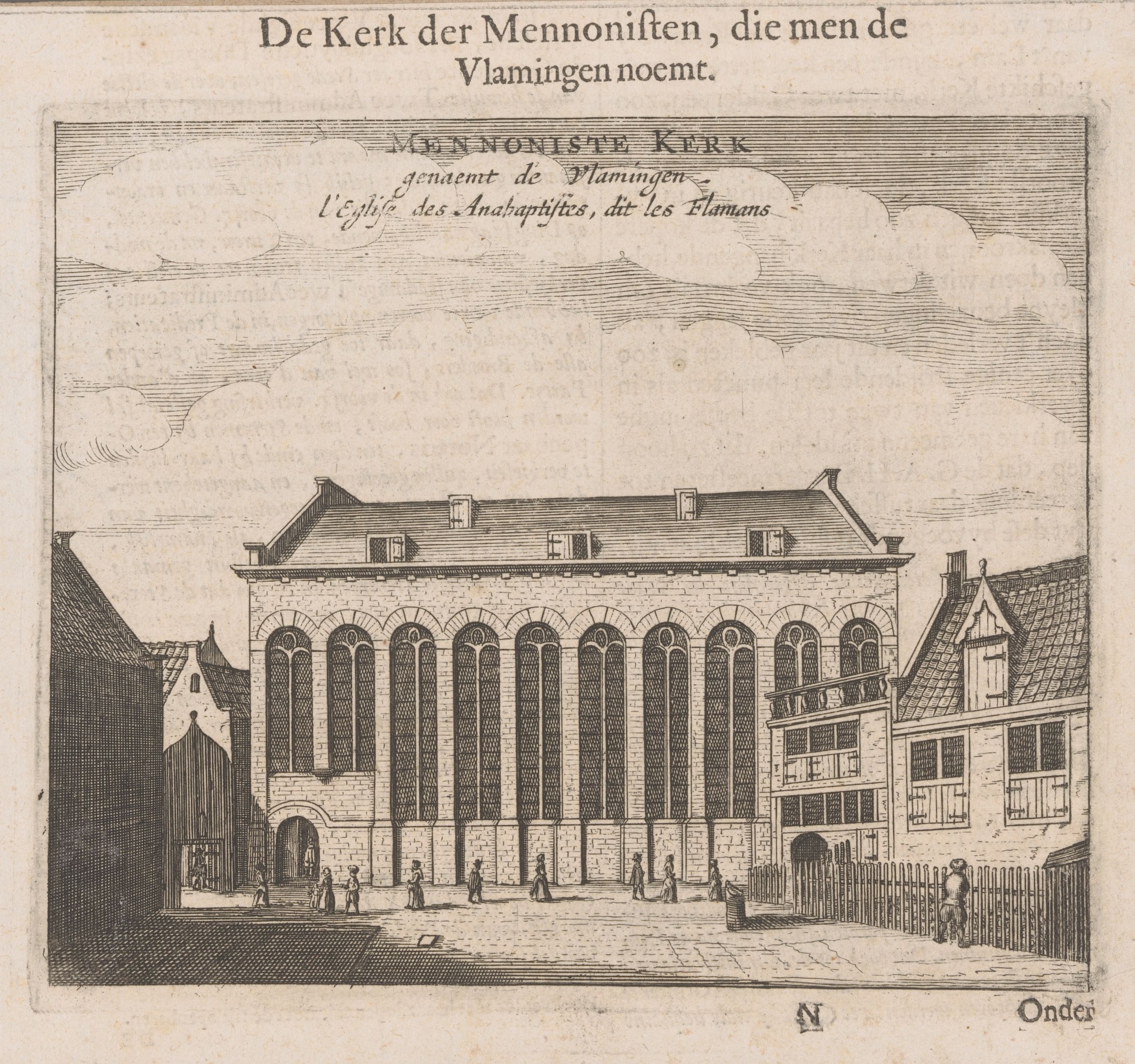
View of the Mennonite Kerk bij 't Lam located between Singel and the Herengracht.
Mennonite churches are distinctive for their particularly sober architecture and unadorned interiors. Historically, the buildings were devoid of art and decoration that might lead the mind toward worldly concerns. In Izaak Commelin’s description of this meeting place, which is paired with an illustration of the church exterior nestled between the Singel and Herengracht, he notes that it is large and finely built and also highlights this congregational concern about maintaining a plain interior. As he recounts, the copper chandeliers were painted over. Another source also includes this anecdote, adding that the chandeliers were painted over so that they would not shimmer in the light and cause distraction. Today, in the Singelkerk, which is now the only remaining, intact Mennonite hidden church in Amsterdam, no one seems to be bothered by the glimmering from the chandeliers – or from the baptismal bowl, which is displayed on a table at the front of the church during Sunday services.
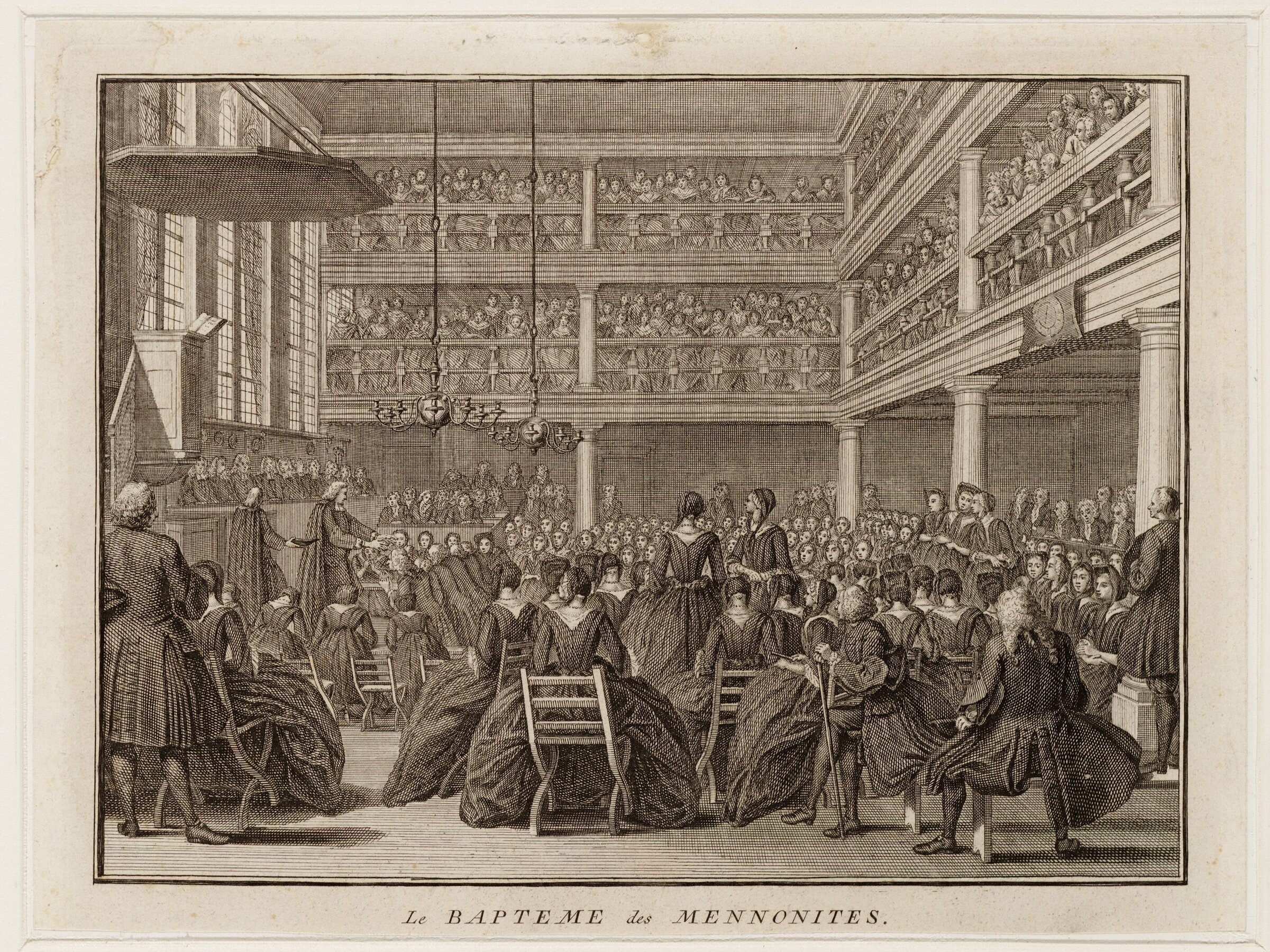
A book illustration of a baptismal service in the Kerk bij 't Lam published in 1736.
An illustration of baptism in the Singelkerk was published in 1736 by Bernard and Picard in their pioneering study comparing the ceremonies and customs of different religious groups. The minister pours water over the head of one of the kneeling baptismal candidates, having scooped it by hand out of a (decidedly less ornate) baptismal bowl that is held by one of the deacons standing next to him. Today baptisms are done much the same way, though the kneeling rails seen in this illustration are no longer used. The congregational setup, with pews and chairs arranged in the round, is also similar, though the men and women no longer sit separately.
Deacon (Mennonite/Doopsgezind)
Deacons were originally appointed to care for the poor and needy of the congregation. However, in the Dutch context, the role was eventually merged with that of church board member. Deacons (and present-day, church board members) participate in aspects of pastoral care and assist with administering baptism and communion. Historically, they also assisted with foot-washing, where that was still practiced; furthermore, they managed church discipline, the ban, and mediation between members.
Nina Schroeder-van 't Schip
Art Historian & Mennonite Heritage Specialist Doopsgezind Amsterdam
Last edited
October 29, 2024
Baptismal bowl, Dickhoff & Salm, 1863, silver-plated tin, 22 x 34 cm. Collection Doopsgezind Amsterdam (Verenigde Doopsgezinde Gemeente Amsterdam).
Interior: photography Nina Schroeder-van 't Schip.
Exterior: photography Robert Westera.
The Singelkerk Exterior, Anonymous, 1665, etching, 139 x 149 mm, in: I. Commelin et al., Beschryvinge van Amsterdam, haar eerste oorsprong uit den huize der Heeren van Aemstel en Aemstellant (...) Book 4 (Amsterdam 1665) 97. Collection Rijksmuseum Amsterdam.
Baptism in the Kerk bij ’t Lam, Balthasar Bernaerts & Louis Fabritius Dubourg, etching and engraving, in: J.F. Bernard and B. Picard, Cérémonies et coutumes religieuses de tous les peuples du monde Volume 4 (Amsterdam 1736) 206-207.
Alle de voornaamste gebouwen der wijtvermaarde koopstad Amsterdam…/Tous les principaux batimens de la fameuse ville Amsterdam… (Amsterdam ca. 1682).
Bernard, J.F. en Bernard Picart, Cérémonies et coutumes religieuses de tous les peuples du monde: representées par des figures dessinées de la main de Bernard Picard; avec une explication historique, & quelques dissertations curieuses, Vol. 4 (Amsterdam 1736).
Commelin, I., et al., Beschryvinge van Amsterdam, haar eerste oorspronk uyt den huyze der Heeren van Aemstel en Aemstellant, 4 (Amsterdam 1665) 97.
Eeghen, I.H. van, “Illustraties van de 17de eeuwse beschrijvingen en plaatwerken van Amsterdam” in: Jaarboek van het genootschap Amstelodamum 66 (1974) 96-116.
Hunt, L., Margaret C. Jacob en Wijnand Mijnhardt, The book that changed Europe: Picart & Bernard's Religious ceremonies of the world (Cambridge 2010).
Voolstra, A., “400 jaar doopsgezinden bij’t Lam in Amsterdam; wat een kerkgebouw kan vertellen over de gemeente die zich er thuis weet,” in: Doopsgezinde Bijdragen (2008) 33-62.
Online sources
Website Doopsgezind Amsterdam
Last visited 10-08-2026