

 Christianity Catholic
The Rich Iconography of the Confessionals of the Church of Our Lady
Below are descriptions of three confessionals in the Church of Our Lady.
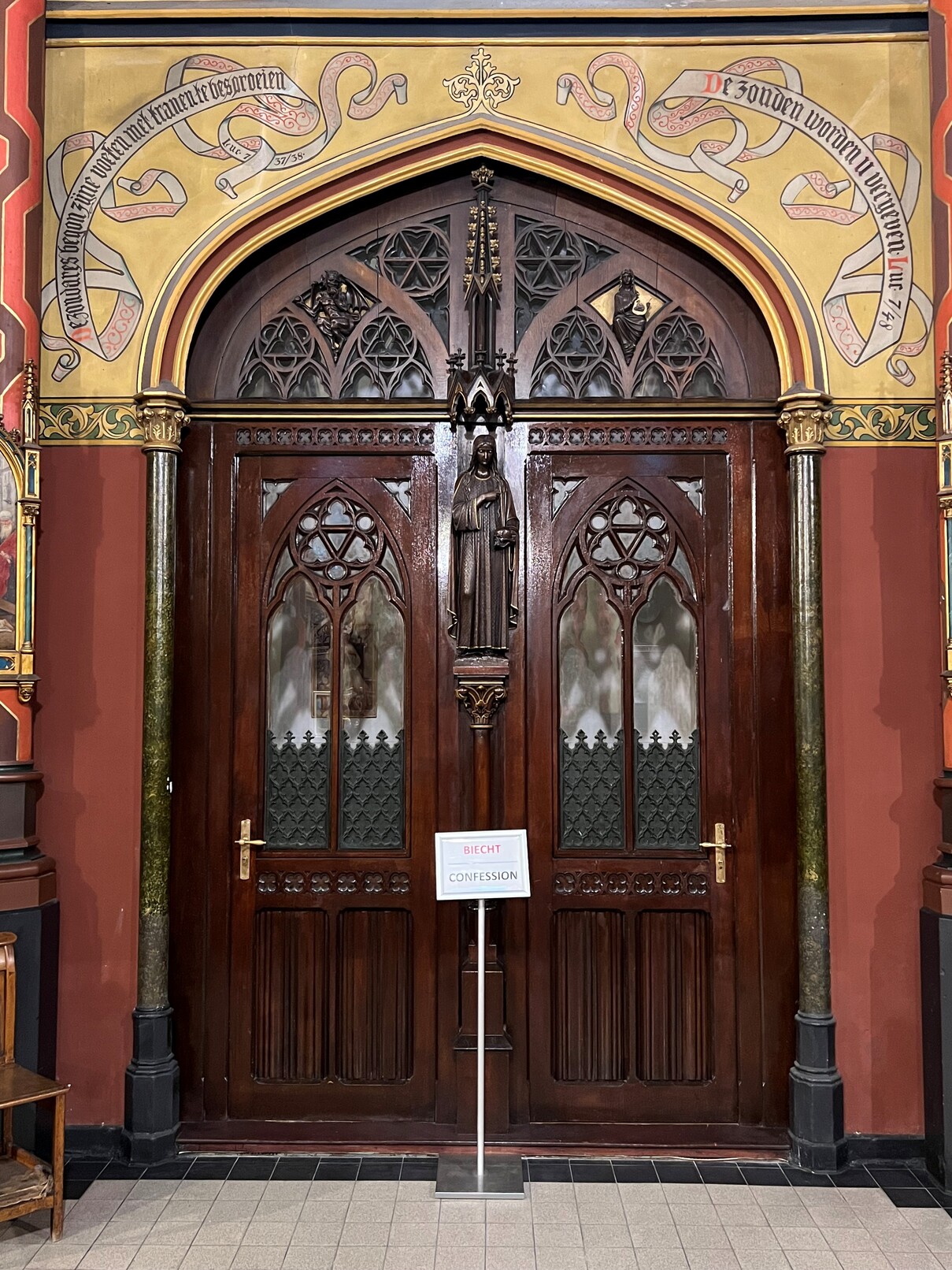
Saint Mary Magdalene is depicted here as a penitent. She wears a penitential robe and has long, loose hair. In her hand, she holds a skull.
According to legend, following the events described in the New Testament, she leads an ascetic life, surviving with almost no food or drink. Above, to her right, the virtue of temperance is depicted by a woman with an image of a camel. On the left, an eating devil is depicted, symbolising gluttony.
The biblical texts above the confessional are traditionally associated with her: “The sinner began to bathe his feet with her tears, Luke 7:37–38” and “Your sins are forgiven, Luke 7:48.”
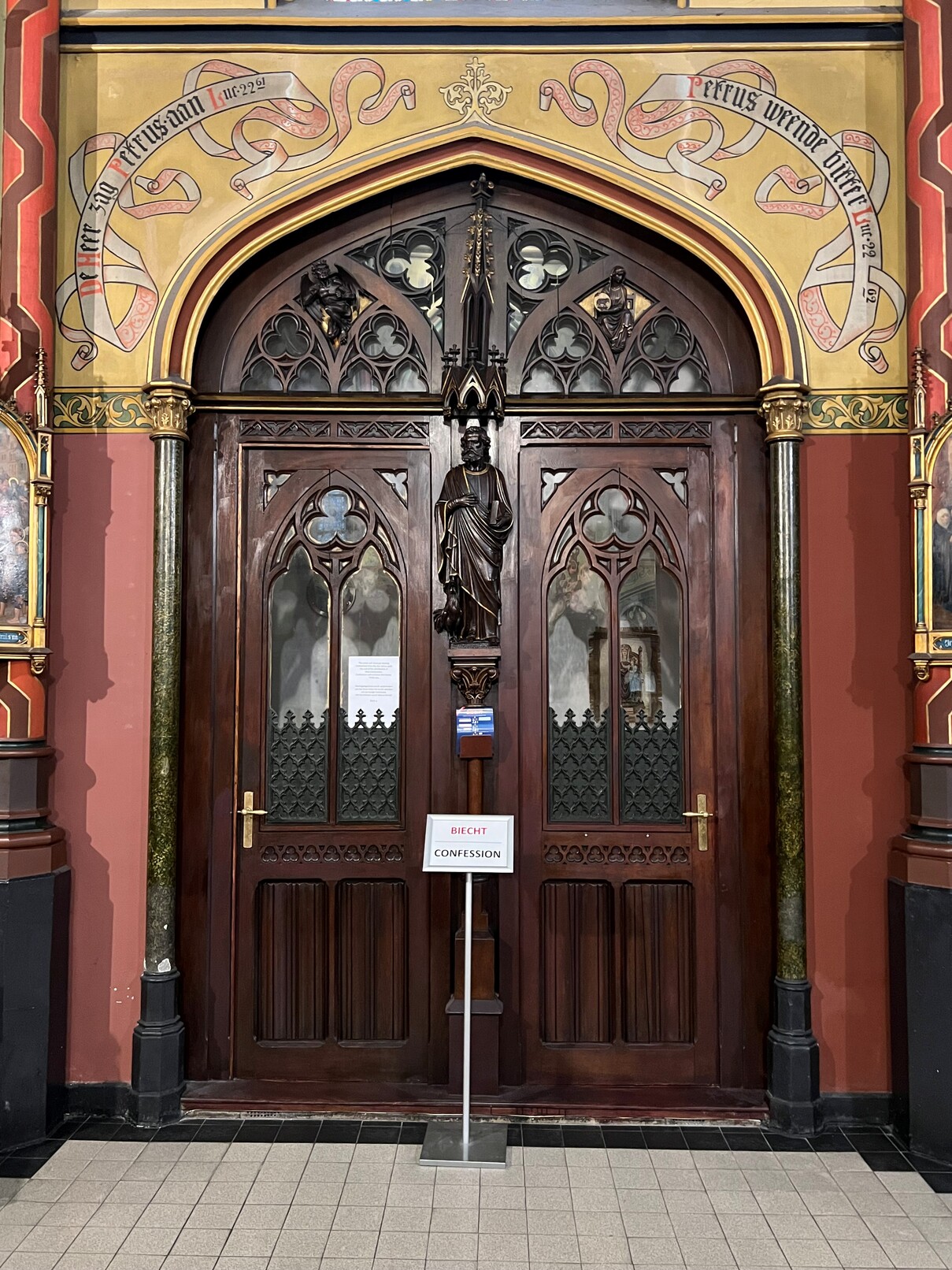
Saint Peter is likewise an example of a good penitent. According to the Gospels, Peter denies Christ after his arrest. He is recognisable here by the rooster at his feet, which refers to the crowing of the rooster after the denial. Unlike the other well-known betrayer, Judas, Peter repents and receives forgiveness.
Referring to his violent actions during Christ’s arrest (Peter cuts off someone’s ear with his sword), anger is depicted in the upper left, symbolised by a devil with clenched fists. On the right, the lamb symbolises gentleness.
Above the confessional are the words: “The Lord looked at Peter, Luke 22:61” and “Peter wept bitterly, Luke 22:62.”
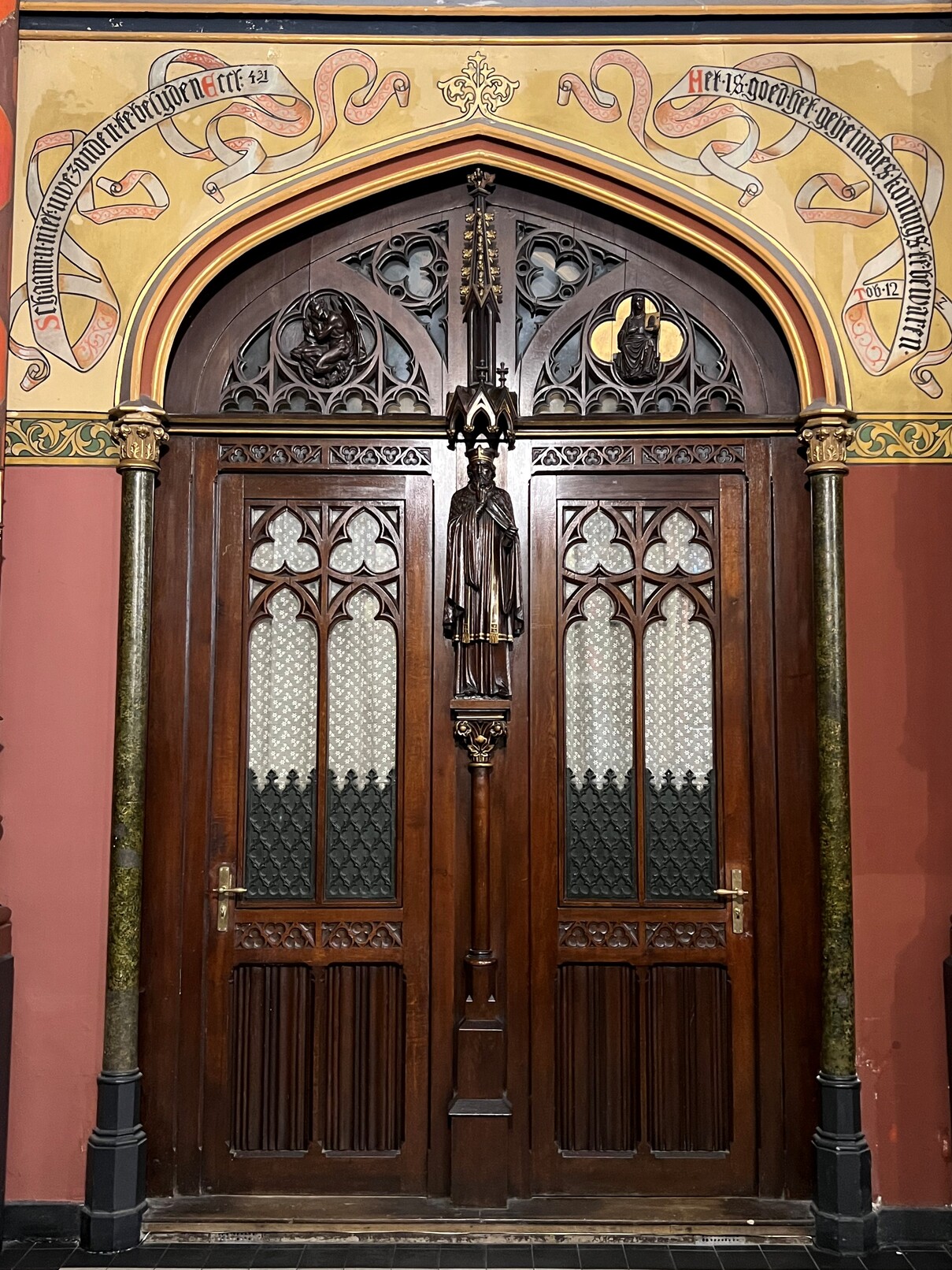
Saint John of Nepomuk was a fourteenth-century Bohemian saint and the patron saint of the seal of confession. In 1393, he was killed on the orders of King Wenceslaus because he refused to break the seal of confession. The statue depicts him with his index finger to his lips, as a sign of his silence.
In the upper right, the beehive symbolises diligence, a reference to his perseverance in protecting the seal of confession. On the left, a sleeping devil symbolises sloth.
The biblical quotations on the wall admonish: “Do not be ashamed to confess your sins, Eccl. 4” and “It is good to keep the king’s secret, Tob. 12:7.”
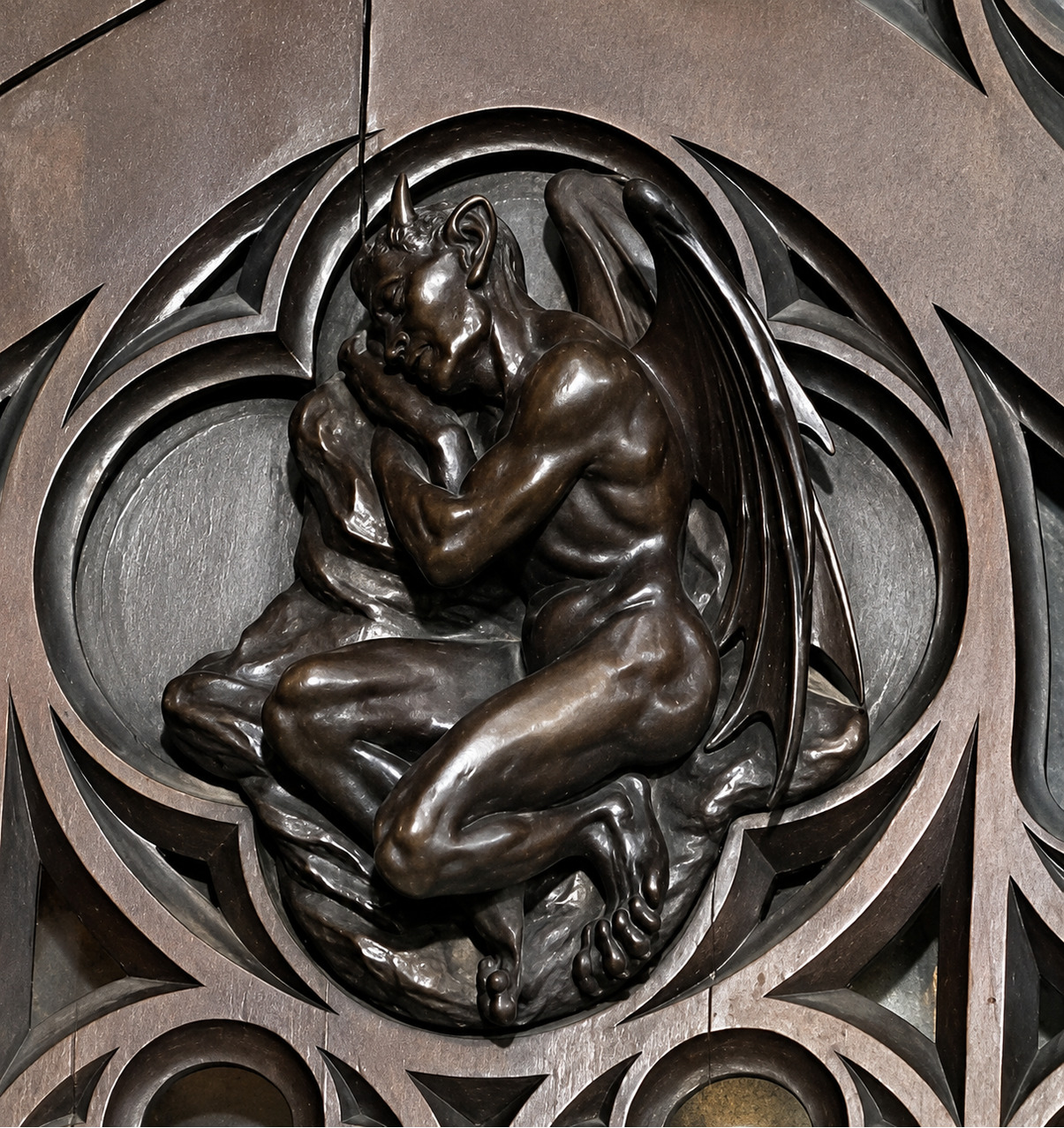
Sleeping devil, symbolising laziness, above the door of the St. John of Nepomuk confessional.
Pieter-Jan van Giersbergen
Curator Collections Our Lord in the Attic Museum
Last edited
August 20, 2026
Confessional of Saint Mary Magdalene, Cuypers-Stoltzenberg Workshop, 1857. Collection of the Moeder Godskerk, Amsterdam. Photograph by Our Lord in the Attic Museum.
Confessional of Saint Peter, Cuypers-Stoltzenberg Workshop, 1857. Collection of the Moeder Godskerk, Amsterdam. Photograph by Our Lord in the Attic Museum.
Confessional of Saint John of Nepomuk, Cuypers-Stoltzenberg Workshop, 1857. Collection of the Moeder Godskerk, Amsterdam. Photograph by Our Lord in the Attic Museum.
The quality of the crop of the last image has been enhanced using AI.
Bakker, M., Onze Lieve Vrouwekerk. Een herboren Monument aan de Keizersgracht (Amsterdam 1998).
Hoogveld, C.J.W.A., Een monument van de katholieke emancipatie : de redemptoristenkerk het ’ Onbevlekt Hart van Maria ’ te Amsterdam (Amsterdam 1983).
Online sources
Website Onze Lieve Vrouwekerk
Last visited 20-08-2026