

 Christianity Protestant
In the Zonshofje, a gable stone and a poem commemorate a hidden church that has vanished and the Mennonite congregations that once gathered there.
Location
Zonshofje
Prinsengracht 171
Type
Hofje
Religious community
Mennonite Church
Object
Gable stone with a poem commemorating a Mennonite hidden church site
Maker and date
Maker unknown
1675
Visit
The hofje and the gable stone are visitable on weekdays via the door at Prinsengracht 159-171
Current exterior
A Gable Stone that Tells a Story
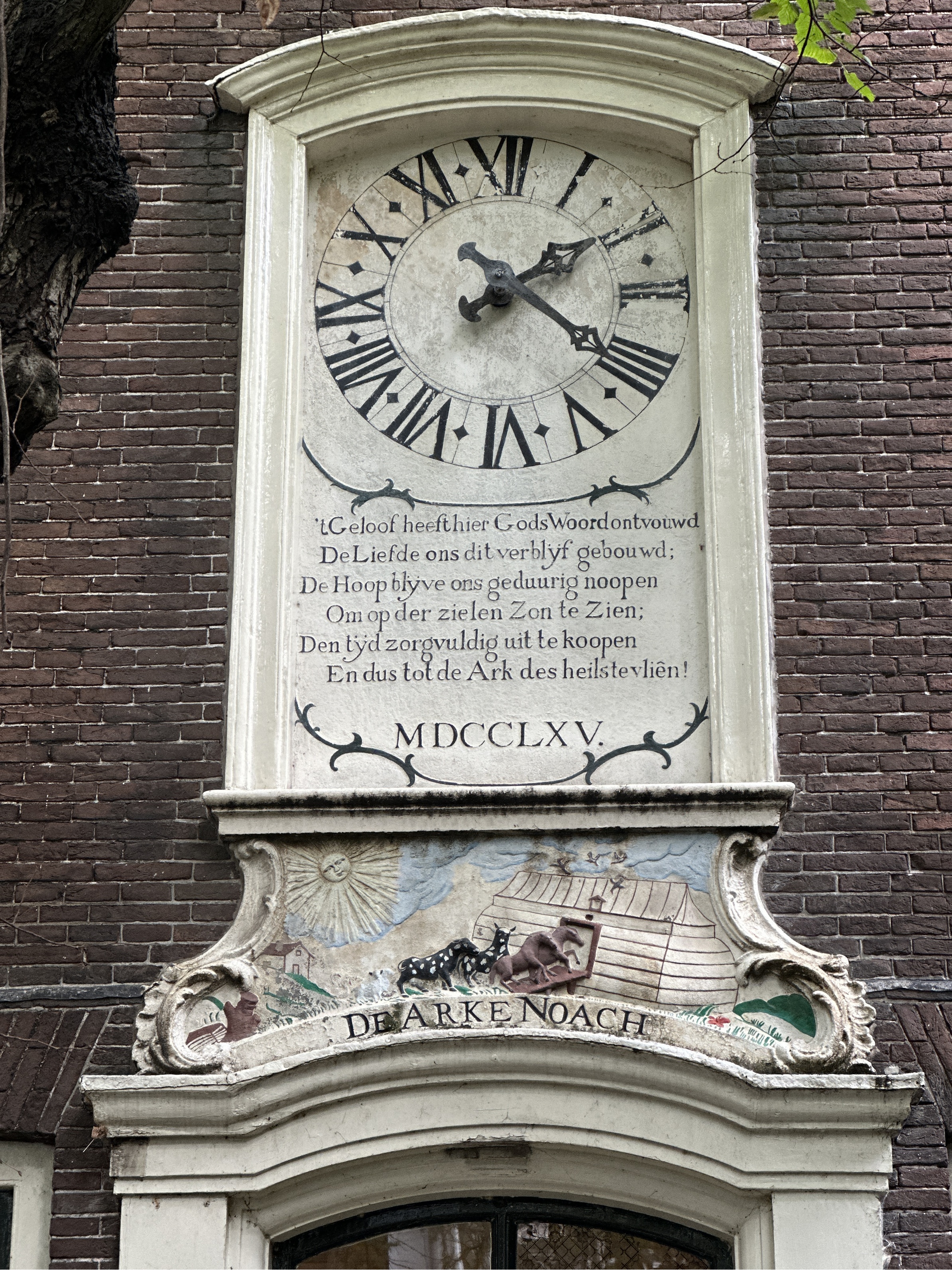
The gable stone inside the Zonshofje’s courtyard depicts the Biblical tale of Noah’s Ark replete with a bright sun shining overhead. Lines of religious poetry beneath the clock remind readers to use their time well and also include some word play on Sun [Zon] and Ark, thereby paying tribute to two former Mennonite congregations that met at this site:
Faith has here God’s Word unveiled;
Love has for us this dwelling built;
May Hope unceasingly compel us
To behold the Sun of souls,
To redeem the time with care,
And thus to flee unto the Ark of Salvation.
MDCCLXV [1765]
From 1671 to 1677, the site was used as a hidden church for a split-off of the larger Zon church on the Singel until the group merged back in with their mother church. They called it De Kleine Zon [the Little Sun]. In 1720, the Old Frisians purchased the former-Kleine Zon alongside an additional ‘achterhuis’ on the Prinsenstraat. They called the church De Arke Noach [Noah’s Ark], keeping the name they had used at previous premises around Amsterdam.
hidden church
Building in which hidden religious services were held in the Dutch Republic (1588-1795). Christian denominations outside the Calvinist church, such as Catholics, Lutherans, Mennonites and Remonstrants, had to practice their religions in hidden churches.
Dutch Mennonite/Doopsgezind subgroups
There were many different branches of Dutch Mennonites in the early modern period, including Old and Young Flemish, Old and Young Frisians, High Germans, Waterlanders, and other splinter groups. Mergers also occurred (eg., the Flemish, Frisians, High Germans, and later also Waterlanders, united with the Flemish at the Kerk bij ’t Lam). As of the 1660s, groups also redivided themselves as Lamists or Zonists (see Lammerenkrijgh). Nearly all groups reunited in Amsterdam in 1801, and nationally in 1811, forming the Algemene Doopsgezinde Sociëteit (ADS).
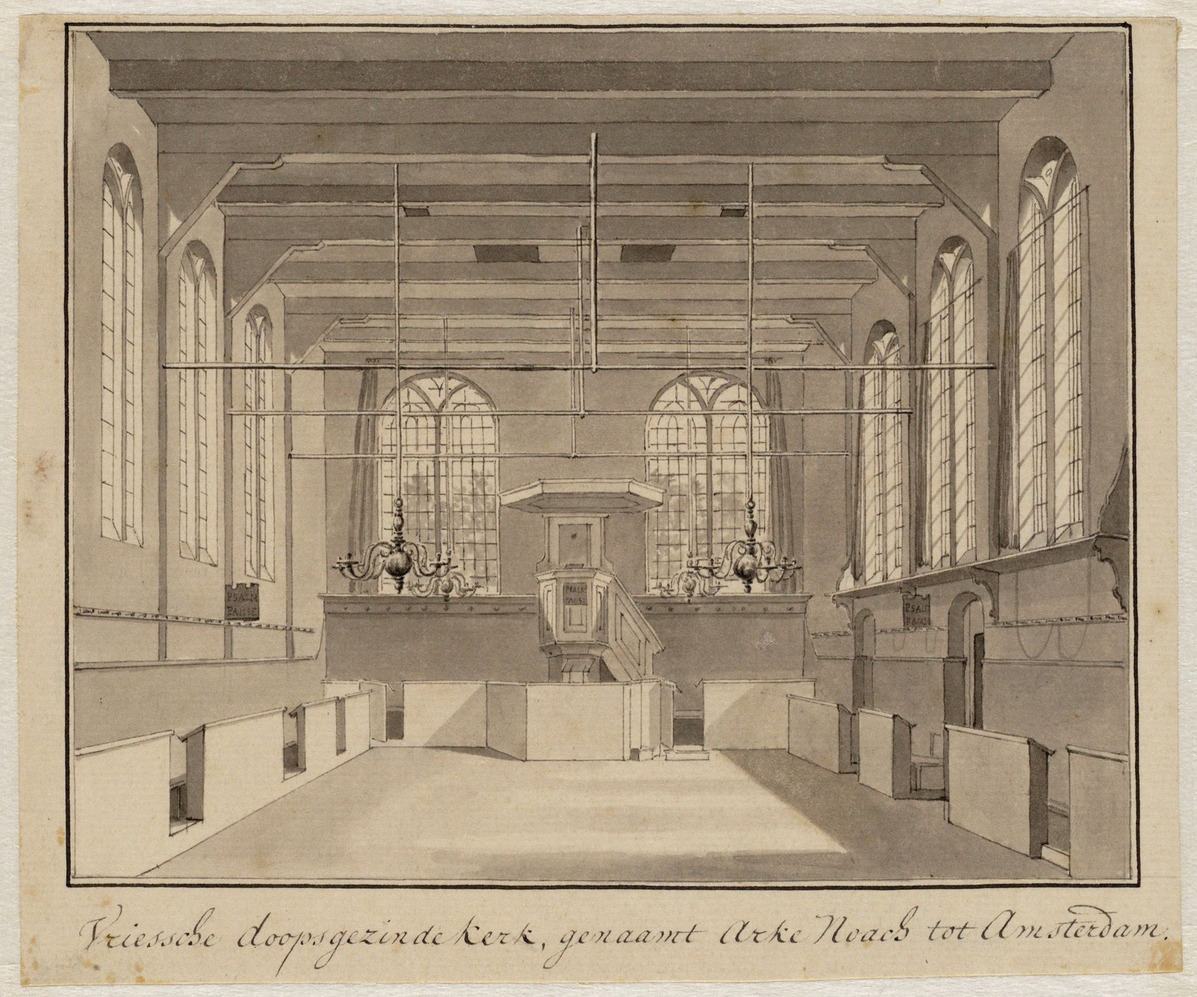
Interior of the former Mennonite hidden church Arke Noach.
In 1752 the Old Frisians too merged with the congregation of the Zon church on the Singel, and the property was converted into a hofje for elderly Mennonite women. It came into use in 1765. Rooms were also made available to house orphans in the building to the right of the entrance hall. Nothing of the original hidden church interior remained after the space was renovated into a hofje. However drawings by draughtsman Cornelis Pronk, who was himself a member of the Old Frisian congregation there, preserve its appearance. These were also used as the basis for prints. Furthermore, Pronk’s student Hendrik de Winter, who was a member of the Zonist congregation, drew the interior of the church during the Lord’s Supper as one of several church illustrations for an extended edition of the Zonist Hermanus Schijn’s Geschiedenis der Mennonieten [History of the Mennonites].
Doopsgezind Amsterdam (formerly VDGA)
Amsterdam’s Mennonite congregation is known today as Doopsgezind Amsterdam. After centuries of divisions and schisms among the Mennonites, during which time the more conservative groups tended to prefer the name Mennoniet [Mennonite] while the more progressive groups went by Doopsgezind [“Baptism community” or “Baptism-minded”], the congregations united in 1801 as the Verenigde Doopsgezinde Gemeente van Amsterdam (VDGA) [United Mennonite Congregation of Amsterdam]. Today, Doopsgezind Amsterdam is comprised of the Singelkerk (at the 17th-century Kerk bij ’t Lam location) and the 19th-century Meerpadkerk in Noord.
Hofje
A hofje is a partly enclosed residential community intended for the needy, such as orphans and widows, usually consisting of a number of small houses arranged around a courtyard or garden. In the early modern period, each religious group in Amsterdam was responsible for caring for its own poor. As a result, the city has a large number of hofjes with various religious backgrounds.
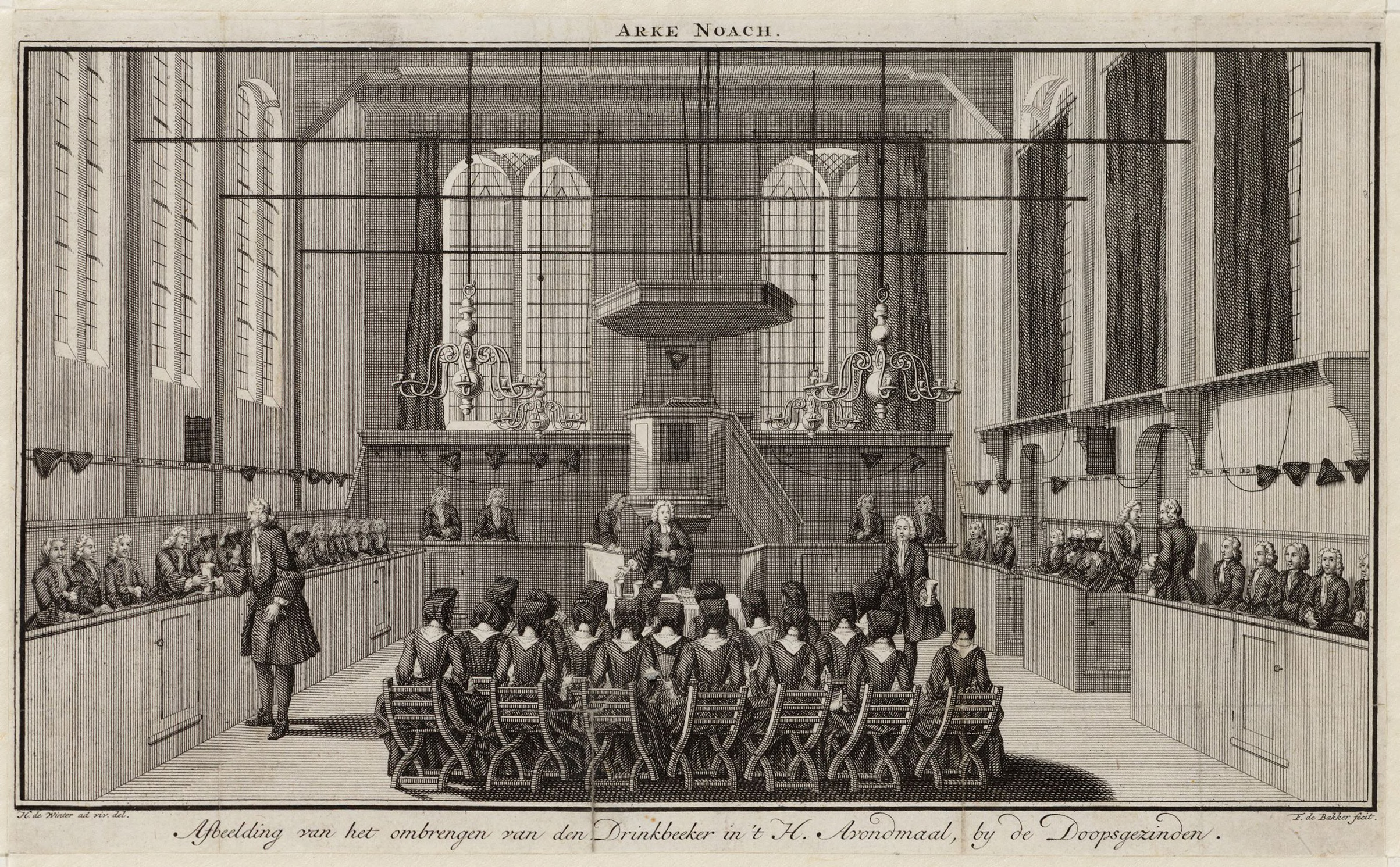
Print of the interior of the hidden church De Arke Noach during the Lord's Supper, based on Hendrik de Winter's illustration of the church.
The hofje continued to serve as a home for the elderly well into the twentieth century, as a group photo from 1913 of the residents on the occasion of a directrice’s 25 anniversary so vividly demonstrates. Today, the hofje, which is still owned and operated by Doopsgezind Amsterdam provides young adult housing: there are 30 rooms for Dutch young people and 7 room for international students connected with study programs of the Doopsgezind Seminarium.
Doopsgezind Amsterdam (formerly VDGA)
Amsterdam’s Mennonite congregation is known today as Doopsgezind Amsterdam. After centuries of divisions and schisms among the Mennonites, during which time the more conservative groups tended to prefer the name Mennoniet [Mennonite] while the more progressive groups went by Doopsgezind [“Baptism community” or “Baptism-minded”], the congregations united in 1801 as the Verenigde Doopsgezinde Gemeente van Amsterdam (VDGA) [United Mennonite Congregation of Amsterdam]. Today, Doopsgezind Amsterdam is comprised of the Singelkerk (at the 17th-century Kerk bij ’t Lam location) and the 19th-century Meerpadkerk in Noord.
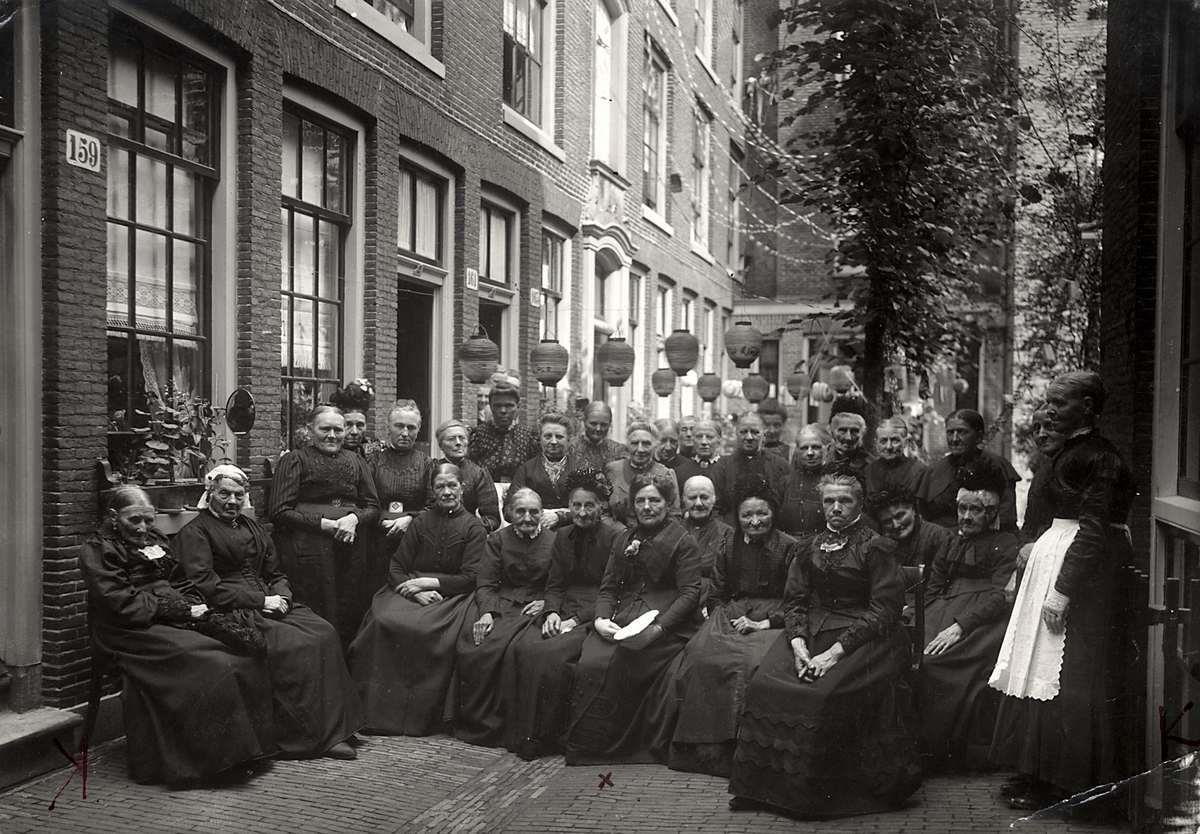
Group photo from 1913 of elderly women residing at Zonshofje.
Nina Schroeder-van 't Schip
Art Historian & Mennonite Heritage Specialist Doopsgezind Amsterdam
Last edited
December 17, 2025
Gable stone, clock, and poem above the door of the Zonshofje, unknown maker, 1675. Collection of Doopsgezind Amsterdam. Photography Our Lord in the Attic Museum.
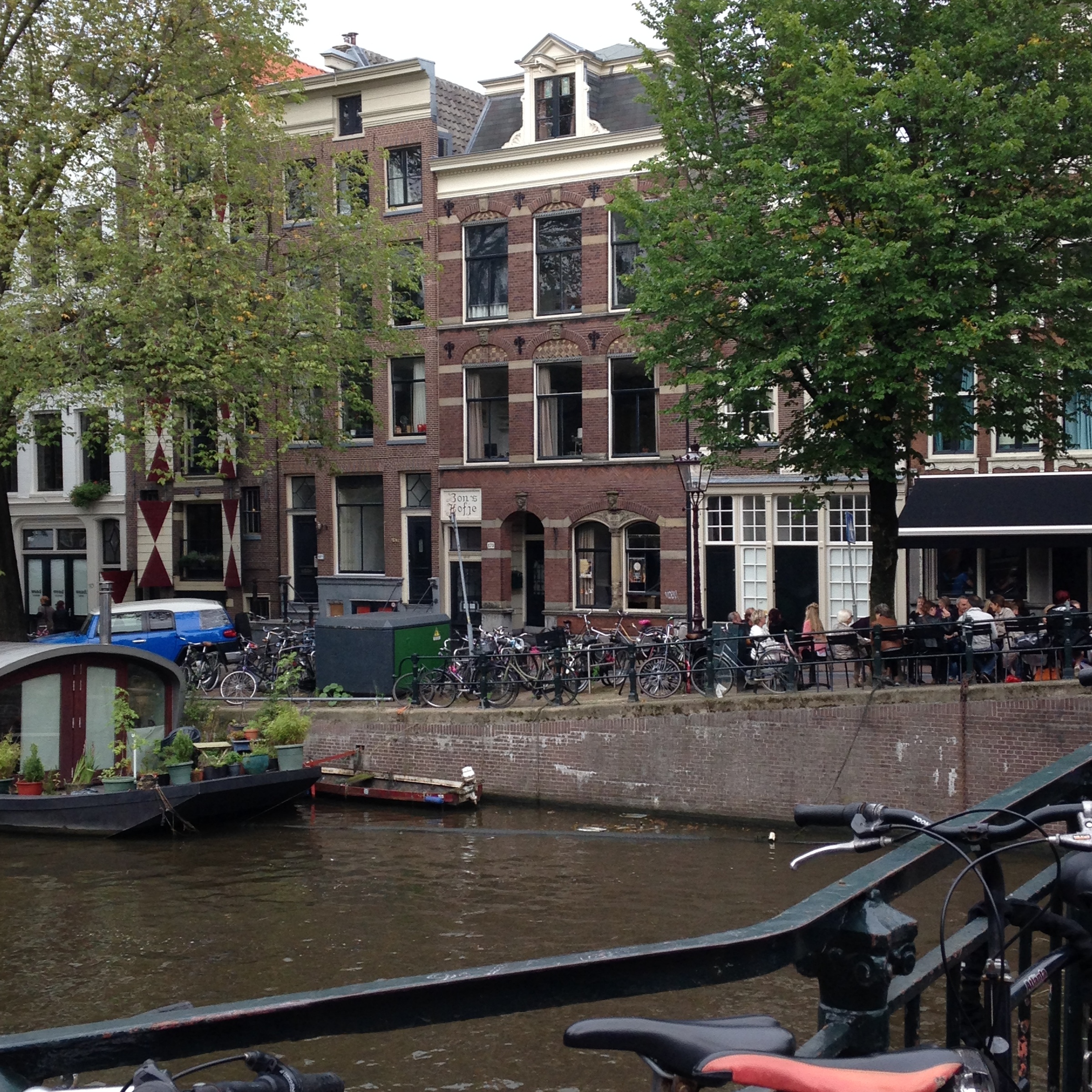
Exterior: Photography Our Lord in the Attic Museum.
Vriessche doopsgezinde Kerk, genaamt Arke Noach tot Amsterdam, Cornelis Pronk, 1729, pen and ink. Collection of Stadsarchief Amsterdam.
Arche Noach. Afbeelding van het ombrengen van den Drinkbeeker in 't H. Avondmaal, by de Doopsgezinden, Hendrik de Winter and Frans de Bakker, 1743, print. Collection of the City Archive Amsterdam.
Group photo of elderly women residing in the Mennonite Zonshofje celebrating the 25th anniversary of the directress A. Visscher, 12 July, 1913. Photography C.J. Hofker. Public Domain.
Gerlagh, B., en Leonard Kasteleyn, Janine Otten, “Leerlingen van Pronk,” in Pronk met Pen en Penseel: Cornelis Pronk (1691-1759) tekent Noord-Holland, A.W. Gerlagh ed. (Amsterdam: De Bataafsche Leeuw 1997) 151-169.
Jong, W. de, en Johan Pennings, Het dopers wandel-boek: Twee wandelingen door Amsterdam (Amsterdam: Verenigde Doopsgezinde Gemeente Amsterdam 2011) 76-78.
Lambour, R., “Doopsgezinde gemeenten te Amsterdam in de zeventiende en achttiende eeuw,” Amstelodamum 100-1 (2013) 24-38, 34-35.
Schijn, H., Uitvoeriger verhandeling van de geschied enisse der Mennoniten, in welke van den oor sprong, naamen, onderscheidingen, eigene, en byzondere leerstucken, belydenissen, en schry vers, als mede van den tegenwoordigen staat dier Christenen in de Vereenigde Nederlanden, die, na Menno Simons, Mennoniten genaamd worden, uitvoeriger gehandeld word (Amsterdam 1744).
Online sources
Website Doopsgezind Amsterdam: Hofjes
Last visited 10-08-2026
Stadsarchief Amsterdam: Vriessche doopsgezinde Kerk, genaamt Arke Noach tot Amsterdam
Last visited 11-12-2025
Amsterdam op de Kaart: Zon's Hofje
Last visited 11-12-2025