

 Christianity Catholic
The French Church, which had been a home to Catholics of many different nationalities for centuries, faced a difficult decision at the beginning of the twentieth century.
Location
French Church
Nieuwezijds Voorburgwal 312
Type
Hidden church
Religious community
Roman Catholic Church
Object
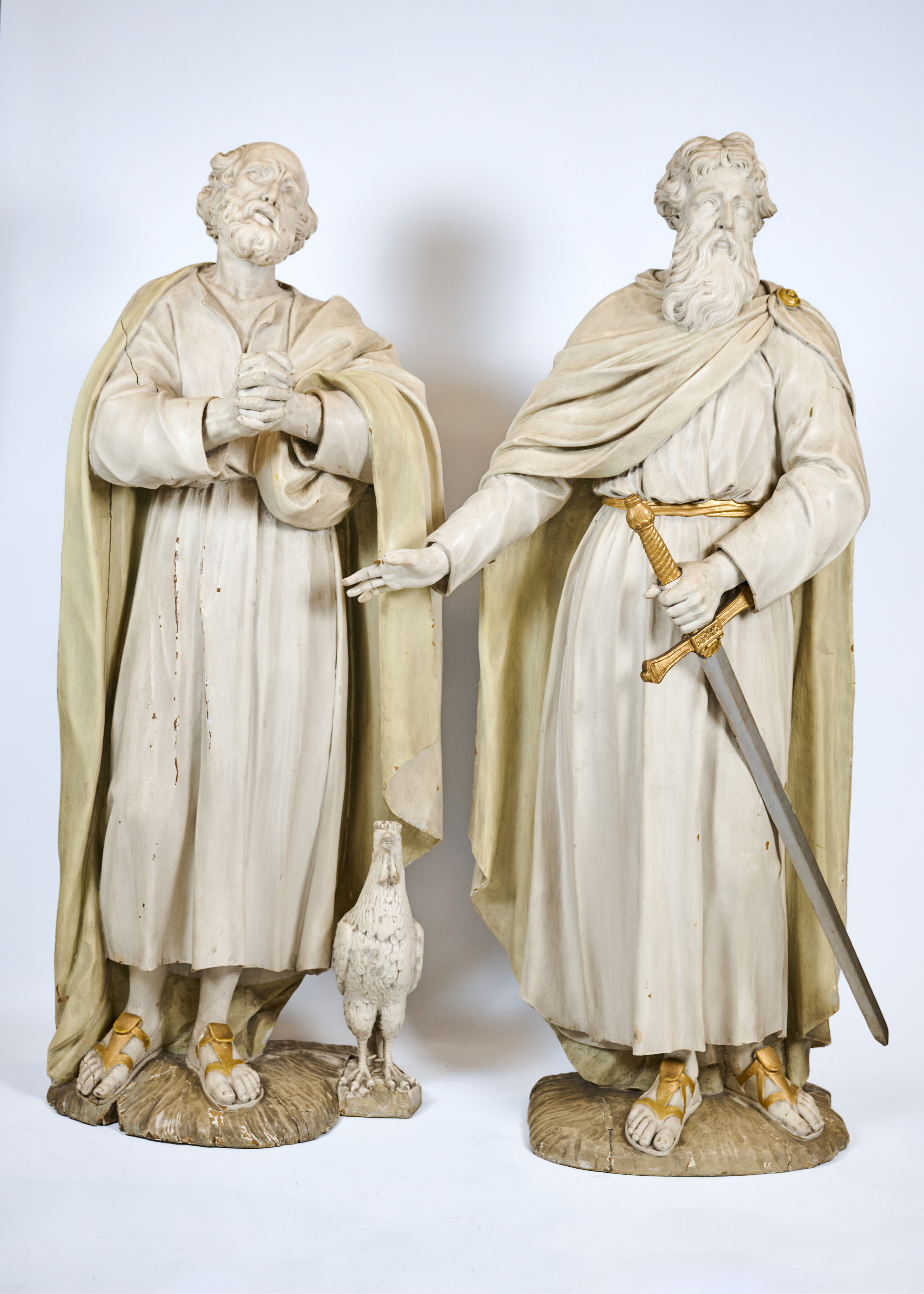
Life-size sculptures of Saint Peter and Saint Paul. Saint Peter is accompanied by a rooster and Saint Paul carries a sword.
Maker and date
Michiel van der Voort de Oude
1735-1736
Visit
The statues are currently not on display
Current exterior

‘It has often been said that it was the “light infantry” of Catholicism who worshipped there; I have never found this to be true. I have always seen that those Italian and French manufacturers, Italian print dealers and chimney sweeps, Italian, French and Brabant merchants and bankers, French booksellers and watchmakers, French hairdressers and dressmakers all prayed very properly and devoutly.’
The author of this quotation, Joseph Alberdingk Thijm, was one of the most passionate Catholic writers in nineteenth-century Amsterdam. In defending the piety of his fellow parishioners of the French Church, he simultaneously describes the great diversity among its worshippers. Yet anyone looking for this church on the Nieuwezijds Voorburgwal today will find nothing there that recalls a Catholic hidden church. Only a few scattered objects preserve the history of the church. The collection of the Our Lord in the Attic Museum contains two life-size statues of Saints Peter and Paul, which originally stood on either side of the high altar. They reveal the church’s official name: the Church of Saints Peter and Paul.
hidden church
Building in which hidden religious services were held in the Dutch Republic (1588-1795). Christian denominations outside the Calvinist church, such as Catholics, Lutherans, Mennonites and Remonstrants, had to practice their religions in hidden churches.
Saint
A Saint is a person who has led an exceptionally holy and virtuous life and is believed to be in heaven. The life of a saint serves as an example for others to follow. Believers pray to the saints and ask them to intercede with God on their behalf.
High altar
The high altar is so called from the fact that it is the chief altar in a church, and also because it is raised on an elevated plane in the sanctuary.
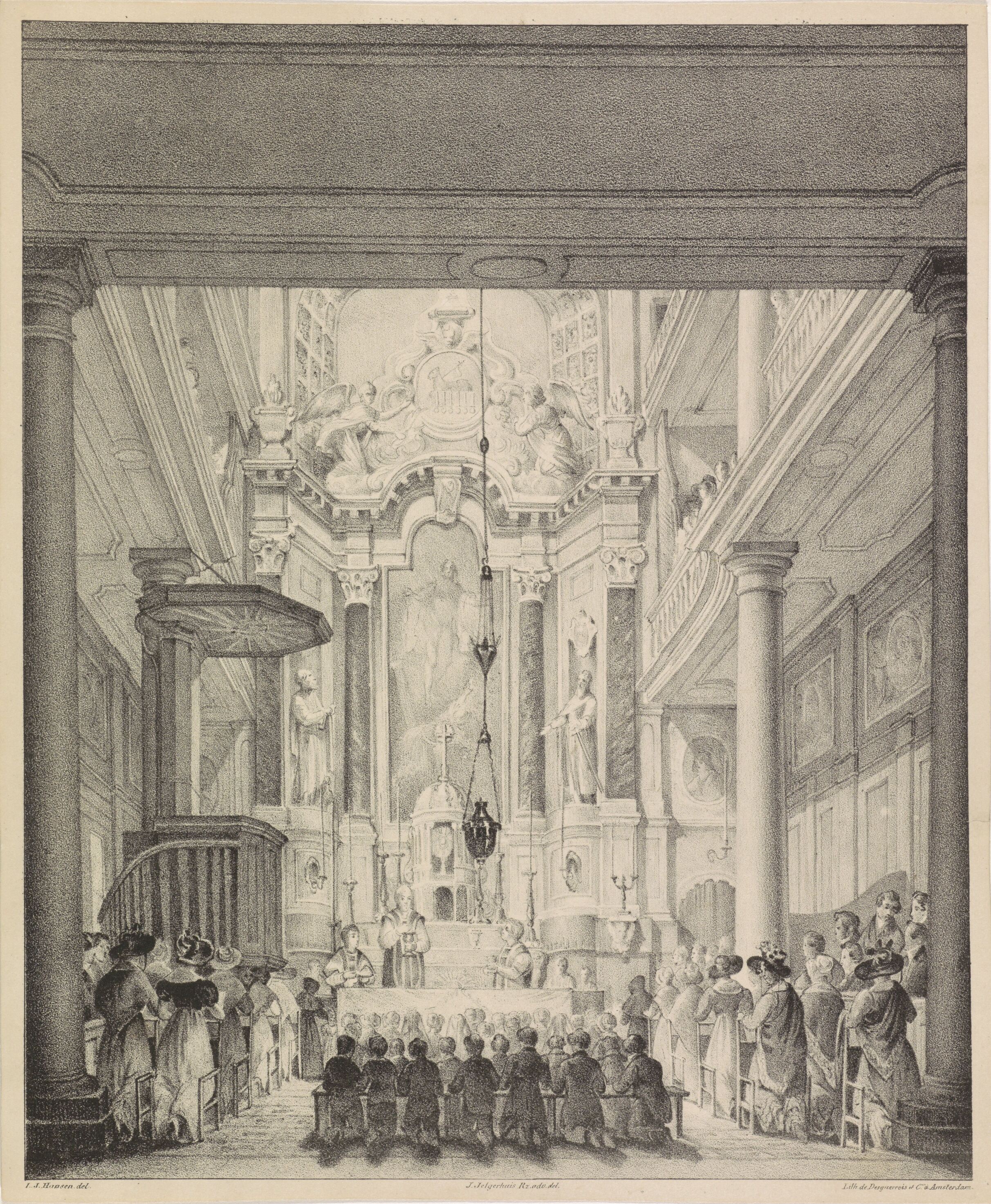
Children kneel before the altar of the French Church to receive their First Holy Communion. The girls kneel at the front and the boys at the back. This print, dating from around 1830, is from the same period in which Joseph Alberdingk Thijm received his First Holy Communion at the French Church.
Around the beginning of the twentieth century, many Amsterdammers leave the old city centre, leaving behind deserted churches. The subsidiary church of the French Church, De Papegaai on the Kalverstraat, had already been converted into a Neo-Gothic church half a century earlier. It was therefore decided to preserve De Papegaai and close the French Church.
Neo-Gothic style
The neo-gothic style is an architectural style that flourished between c. 1830-1910, reviving medieval Gothic architecture.
Subsidiary church
A subsidiary church is a smaller church building that falls under the main church of a parish or district. Such churches are usually established to relieve an overcrowded parish church, or to provide a more convenient place of worship for worshippers who live too far from the main church.
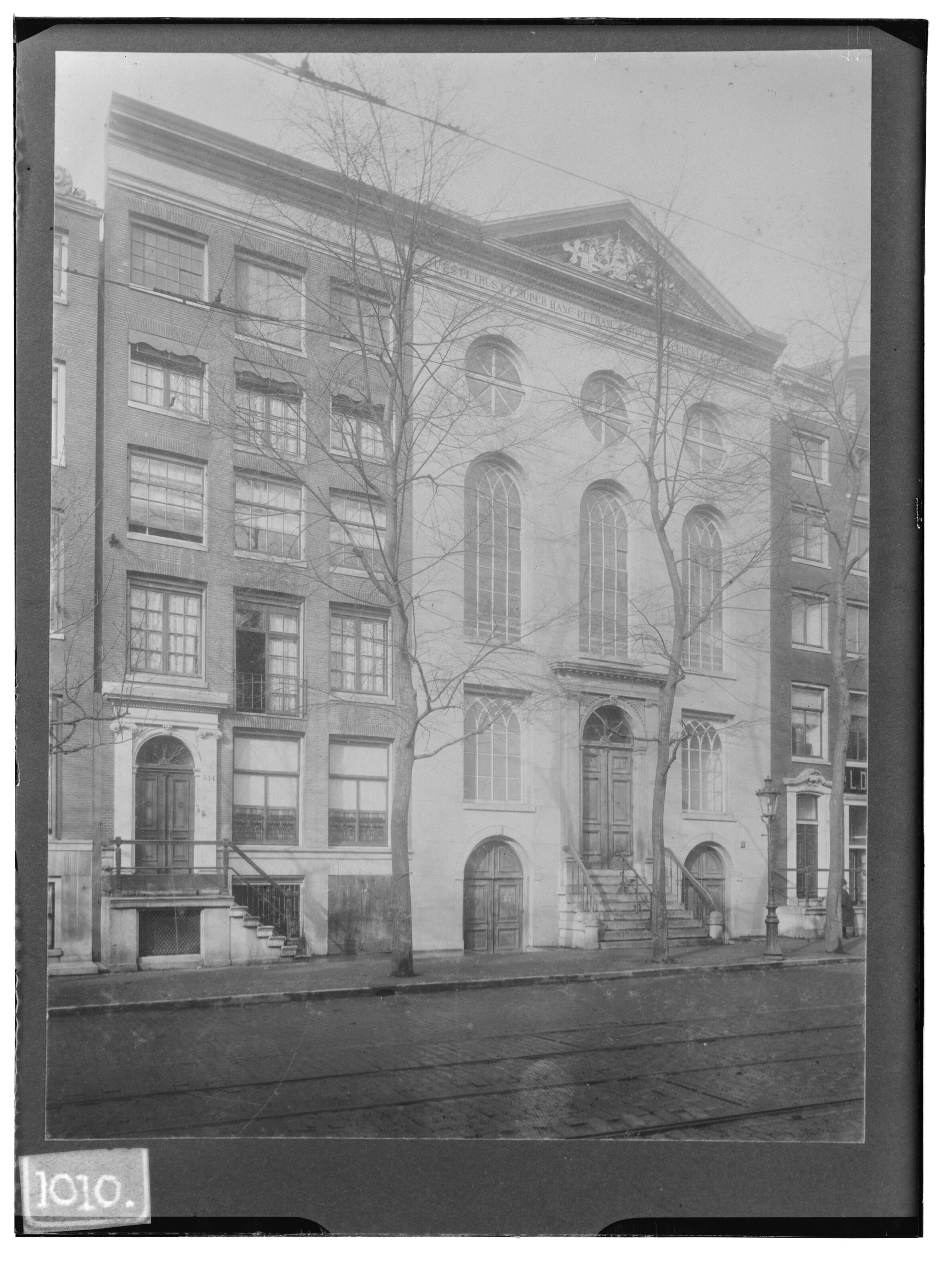
Exterior of the French Church shortly before its demolition. In 1820, the building was given a new façade, making the previously concealed clandestine church visible from the street.
The closure of a church was an unusual event in 1911. The highest ecclesiastical authorities in Rome were involved in the process. On 30 May 1911, their conditions arrived: ‘The only condition imposed will be that the building shall not be used for less respectable purposes and that, in remembrance of its former use, a cross shall be placed on the façade.’ The local church authorities took the condition that the building should not be used for ‘less respectable purposes’ extremely seriously. To be on the safe side, the French Church was therefore completely demolished in 1912.
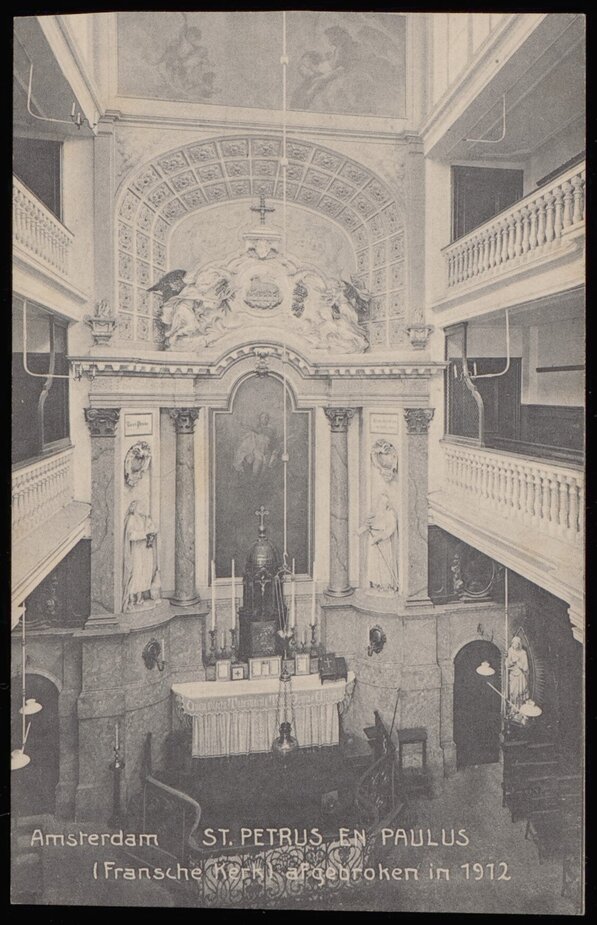
Interior of the French Church, shortly before its demolition in 1912. The statues of Saints Peter and Paul stand in prominent positions beside the altar.
Pieter-Jan van Giersbergen
Curator Collections Our Lord in the Attic Museum
Last edited
September 30, 2026
Peter (workshop of) M. van der Voort de Oude, 1735-1736, limewood, 172 x 85 x 80 cm. Collection of the Roman Catholic Church of St Joseph (De Papegaai), long-term loan at the Our Lord in the Attic Museum, Amsterdam.
Paul, (workshop of) M. van der Voort de Oude, 1735-1736, limewood, 172 x 115 x 75 cm. Collection of the Roman Catholic Church of St Joseph (De Papegaai), long-term loan at the Our Lord in the Attic Museum, Amsterdam.
Exterior: photography Robert Westera
Toelating van kinderen tot de eerste heilige communie in de rooms-katholiek Franse kerk op de Boommarkt te Amsterdam, ca. 1830, design by Lambertus Johannes Hansen after a drawing by Johannes Jelgerhuis, publisher Desguerrois & Co., 1830-1835, lithograph, 258 x 213 mm. Collection of the Rijksmuseum, Amsterdam.
Nieuwezijds Voorburgwal 312, unknown photographer. Collection of City Archives Amsterdam, Archief van het Bureau Monumentenzorg: glasnegatieven en negatiefloze foto's.
De Fransche kerk op Nieuwezijds Voorburgwal 312, interieur, unknown photographer, 1910-1933, picture postcard. Collection of City Archives Amsterdam: prentbriefkaarten.
Plas, M. van der, Vader Thijm: Biografie van een Koopman-schrijver (Baarn 1995).
Tepe OP, W., XXIV Paepsche Vergaderplaatsen: Schuilkerken in Amsterdam (Amstelveen, 1984).
'Fransche Kerk' in: Geïllustreerd zondagsblad voor katholieken, 29 (Amsterdam 1911-12) 225-229.
Grijpink, P.M., ‘De Parochie van de H.H. Petrus en Paulus te Amsterdam’ in: Bijdragen voor de geschiedenis van het Bisdom van Haarlem, 30 (1906) 423-452.