

 Christianity Protestant
When the Eilands-church finally opens its doors after years of waiting, money to maintain the church proves difficult to secure.
Location
Eilandskerk
Bickersgracht 1
Type
Church
Religious community
Dutch Reformed Church
Object
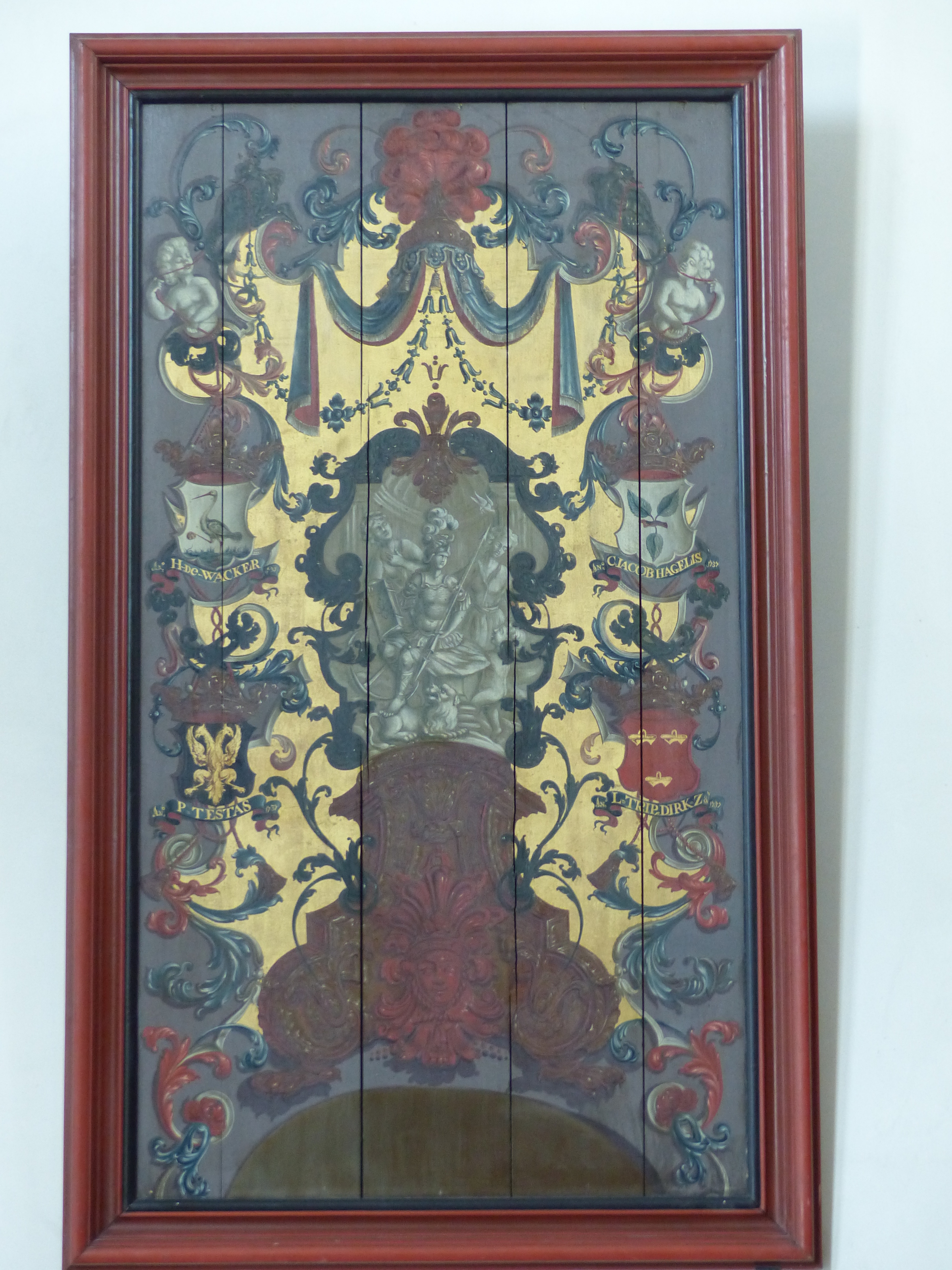
Wooden panel with the names of churchwardens and a representation of Faith, Hope and Charity
Maker and date
Maker unknown
1737
Visit
On display in the Noorderkerk
At last, a church building to be proud of
The churchwardens of the Eilandschurch must have been proud when, on 9 December 1736, the minister Cornelis van Rhijn (1683–1745) climbed the pulpit for the first time. After years of waiting, the wooden Eilands-Loost on Bickerseiland had been replaced by a stone church building. Four of the churchwardens made sure this historic event did not pass unnoticed: they had their names and coats of arms painted on this large wooden churchwardens board. Being a churchwarden was generally considered an honorary position, a role that only the burgomasters could bestow. Once appointed, a churchwarden was responsible for the income and expenditures needed to maintain the church building. In return for this considerable work, they enjoyed the use of a private pew and a well-appointed churchwardens’ room.
Churchwarden
In the Protestant Church, the churchwarden is responsible for managing the buildings, the paid and volunteer workers in the church and the financial management of the community. The duties of a church warden also include managing and maintaining the baptism book (mandatory), confession book (mandatory) and wedding book (not mandatory).
Pulpit
The pulpit is an elevated place in a church from which the spiritual leader addresses the congregation.
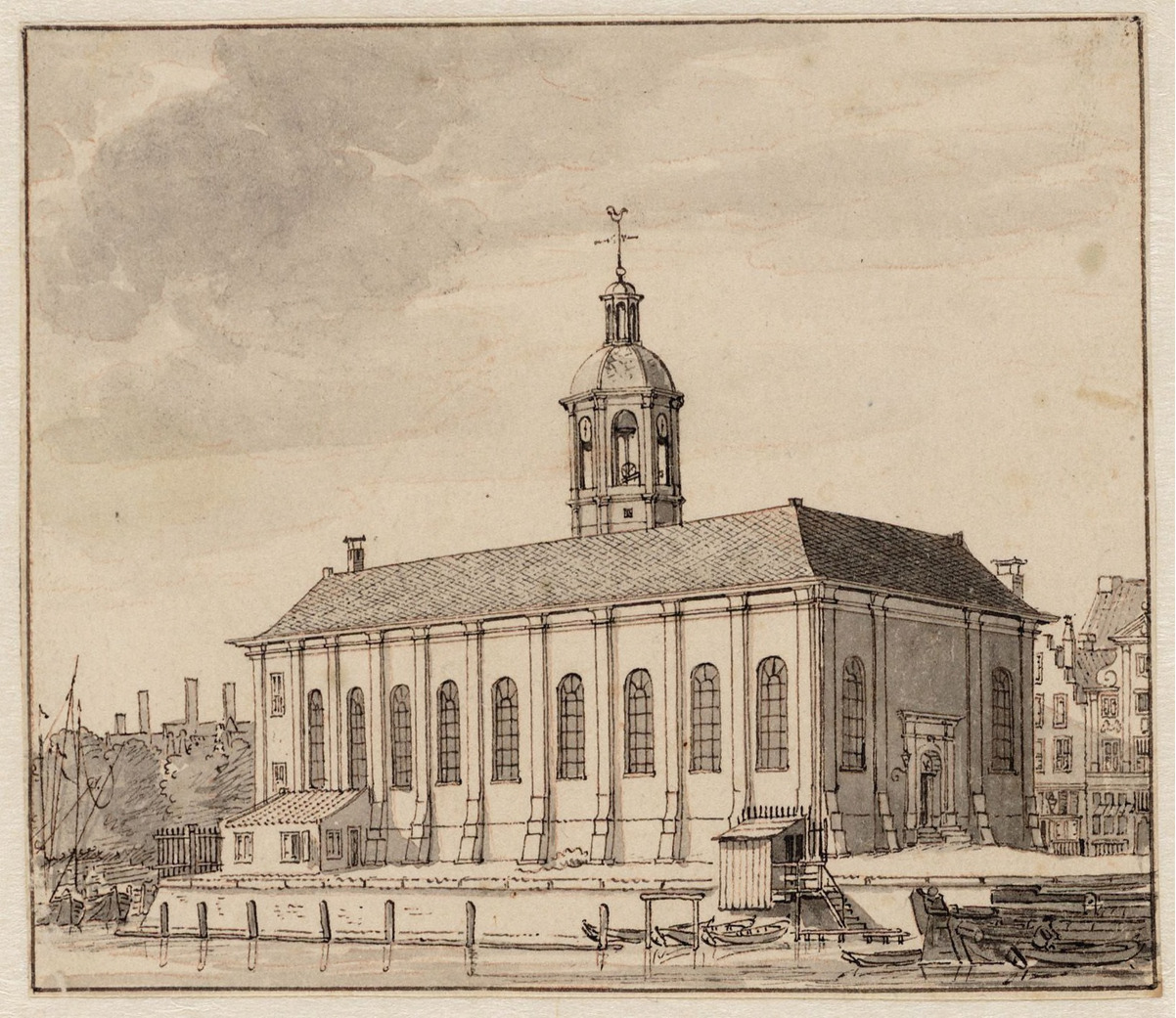
The Eilandschurch on the Bickerseiland was closed in 1939 and demolished in 1950.
A church for millers, ship-woodcarvers, and carpenters
Most Amsterdam churchwardens obtained their funds through the sale of graves and the rental of pews. For most churches in the city this system worked well, but the Eilandschurch turned out to be an exception.
The gravedigger of the Eilandschurch had the habit of noting the occupation of every person he buried. We find names such as Aafje van Molen De Buijs, Abraham the ship’s biscuit baker, and Cornelis the ship’s woodcarver. Many members of this congregation worked at shipyards or in the surrounding mills. People in these trades generally did not purchase their own graves but were buried in rented ones. Nor did they rent expensive seats in the baptistery or in one of the gentlemen’s pews; instead, they sat in the free seating at the back of the church.
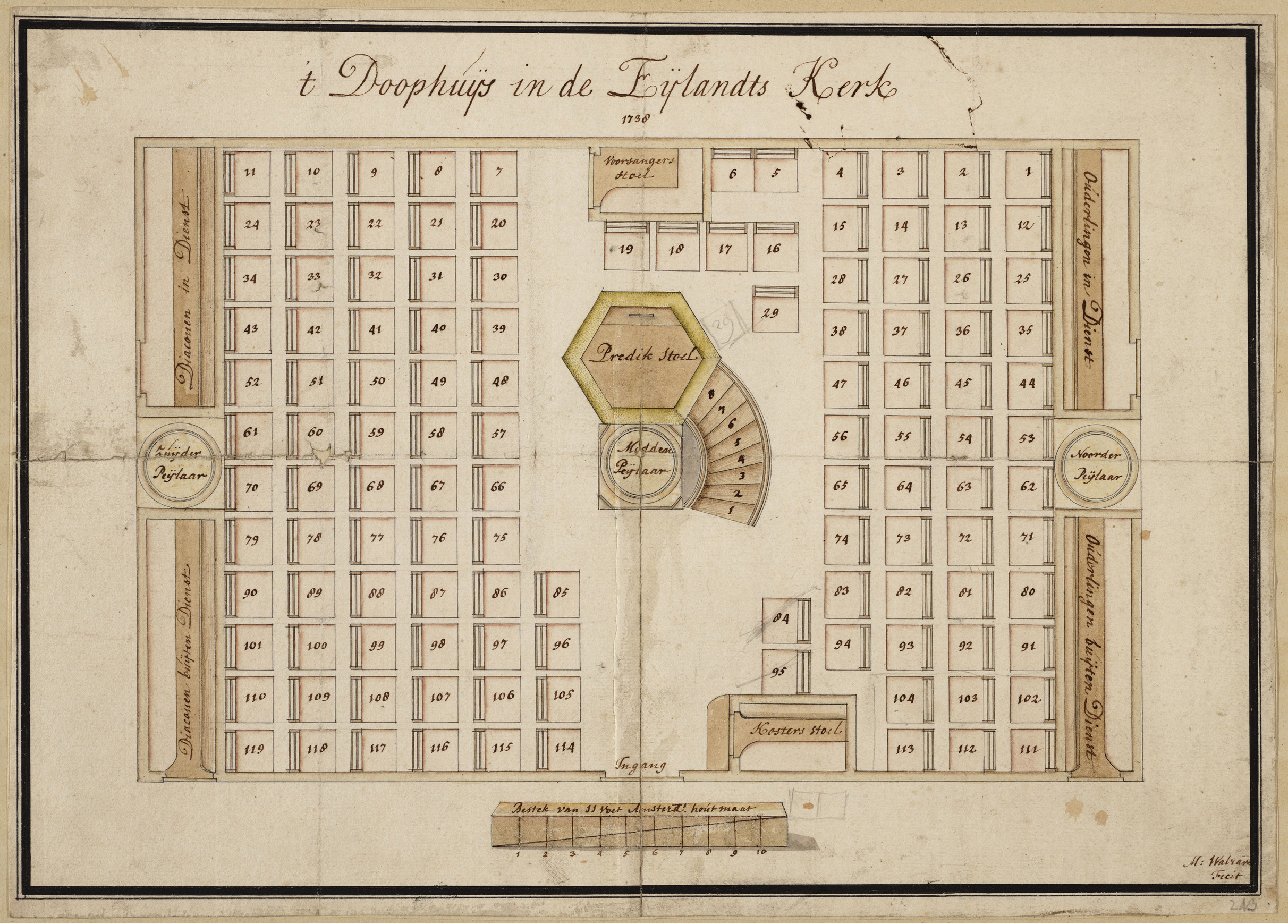
Floor plan showing the mapped seating around the pulpit in the baptistery of the Eilandschurch.
Struggling for a steady income
Years after the church was brought into use, fewer than one-third of the pews had been rented out, and grave sales lagged behind. Consequently, the churchwardens had very little income to maintain the building, as evidenced by the many letters they sent to the burgomasters requesting additional funds. The Eilandskerk managed to endure for two hundred years, until the building was closed in 1939 and demolished eleven years later. The remaining members of the congregation moved to the Noorderkerk, taking the 1737 churchwardens’ board with them.
Celine Oldenhage
Archivist Waalse Gemeente Amsterdam / Member of the Art Committee of the Protestant Church of Amsterdam
Last edited
December 17, 2025
Churchwardens’ board with the names of the churchwardens from 1737 and an allegorical representation of Faith, Hope, and Charity, maker unknown, 1737, wood, ca. 200 × 100 cm. Collection of the Protestant Church of Amsterdam. Photo: Kerkcollectie Digitaal Museum Catharijneconvent, Marco Blokhuis.
Exterior: photography
Exterior view of the Eilandskerk, Jan Bulthuis, c. 1775, chalk drawing. Collection Stadsarchief Amsterdam.
Floor plan showing the mapped seating around the pulpit in the baptistery of the Eilandskerk, Maurits Walraven, 1738. Collection Stadsarchief Amsterdam.
Emous, F.D., De Eilandskerk. Uitgegeven ter gelegenheid van het 200-jarig bestaan der kerk op woensdag 9 december 1936 (Amsterdam 1936).
Wagenaar, J., Amsterdam in zijne opkomst, aanwas. Geschiedenissen […] (Amsterdam 1765).