

 Christianity Protestant
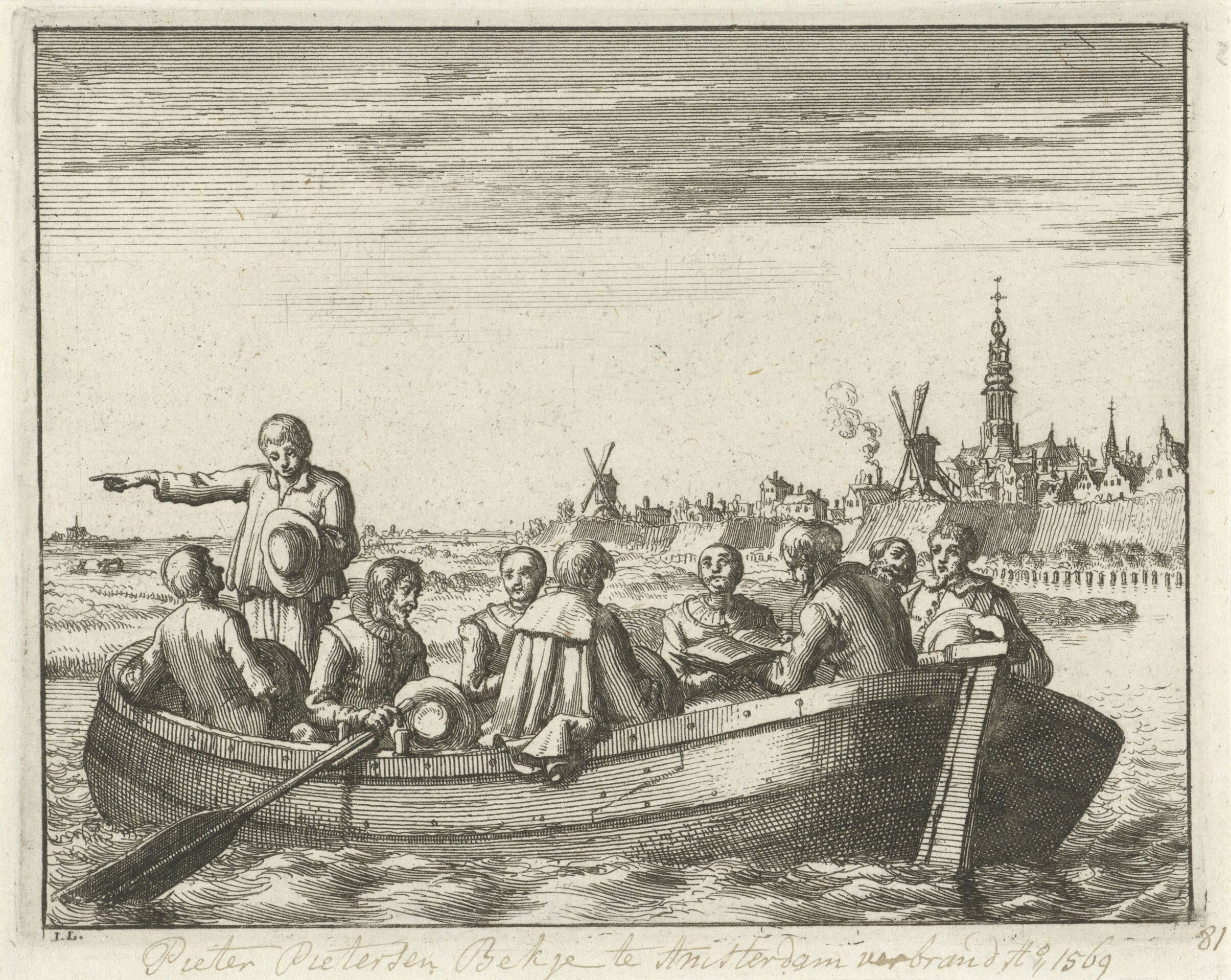
It was dangerous to be an Anabaptist in the sixteenth century so meetings took place in secret, ever-changing locations: this martyrology illustration depicts one such worship gathering on a ferryboat.
Location
Clandestine Anabaptist Gathering on a boat
Amstel 110G
Type
Religious place of assembly
Religious community
Mennonites/Doopsgezinden (16th-Century Anabaptists)
Object
Etch showing a clandestine worship gathering of Anabaptists on the Amstel river.
Maker and date
Jan Luyken
1685
Visit
Not on display
Weetdoeners and Martyrdom: Clandestine Anabaptist Gatherings in the 16th Century
Amsterdam’s Anabaptists, soon known as Mennonites (after Menno Simons) or as Doopsgezinden, in reference to their practice of adult baptism, found themselves facing the death sentence not long after the movement was introduced to the city in 1530. For decades, they worshipped in secret, moving their meeting locations often. A weetdoener would sneak out and share the agreed upon location with fellow members ahead of each meeting. There are few concrete locations linked to this earliest history – though, apparently until about the 1580s, there were often meetings in homes around the Nieuwendijk and the old Haarlemmersluis. Makeshift outdoor locations were also used: Pieter Pietersz. Beckjen’s ferryboat on the Amstel doubled as one such worship place.
Baptism
Baptism is a Christian initiation ritual. The person who is to be baptised has water poured over them, or is fully immersed in baptismal water. This is done in imitation of Jesus Christ, who was baptised by John the Baptist in the Jordan River.
Menno Simons
The term “Mennonite” comes from the name of Menno Simons (1496-1561), a Frisian Priest who converted to Anabaptism in the 1530s, and emerged as one of several important early leaders of the movement after the fall of certain revolutionary and apocalyptically-oriented branches of Anabaptists. Later, a group that split away from those known as Mennonites in the 1550s chose instead to be called Doopsgezinden (“baptism-community” or “baptism-minded”). In the Dutch Republic times, the name Doopsgezind was often the name preferred by Mennonite groups who were more progressive in their theology or lifestyle.
Dutch Anabaptist Beginnings
The Anabaptist groups which began to emerge as of 1525 in the Swiss Cantons, and also developed in other parts of early modern Europe, were remarkably diverse. The belief in adult baptism was generally held in common, but views on the relation between Bible and spirit, eschatology, and ecclesiology differed substantially. Anabaptism began to spread in the Low Countries – and also in Amsterdam – as of 1530, developing within a context of anticlericalism and reform sentiment that had already started to develop. That year, Jan Volkertsz. Trypmaker, a disciple of the Anabaptist Melchior Hoffman, arrived in Amsterdam and introduced Anabaptism to the city.
Weetdoener
There is evidence that in Amsterdam, and Antwerp - and very likely in other large cities - one Anabaptist was trusted with the role of “weetdoener.” The Dutch word roughly translates to “knowledge-sharer” or “knowledge-giver.” This person went from member to member in order to secretly spread the news of the next meeting location as well as the planned time for the meeting. These locations and times always varied due to the mortal danger associated with being an Anabaptist (a so-called “Wederdoper”) until the late 1570s.
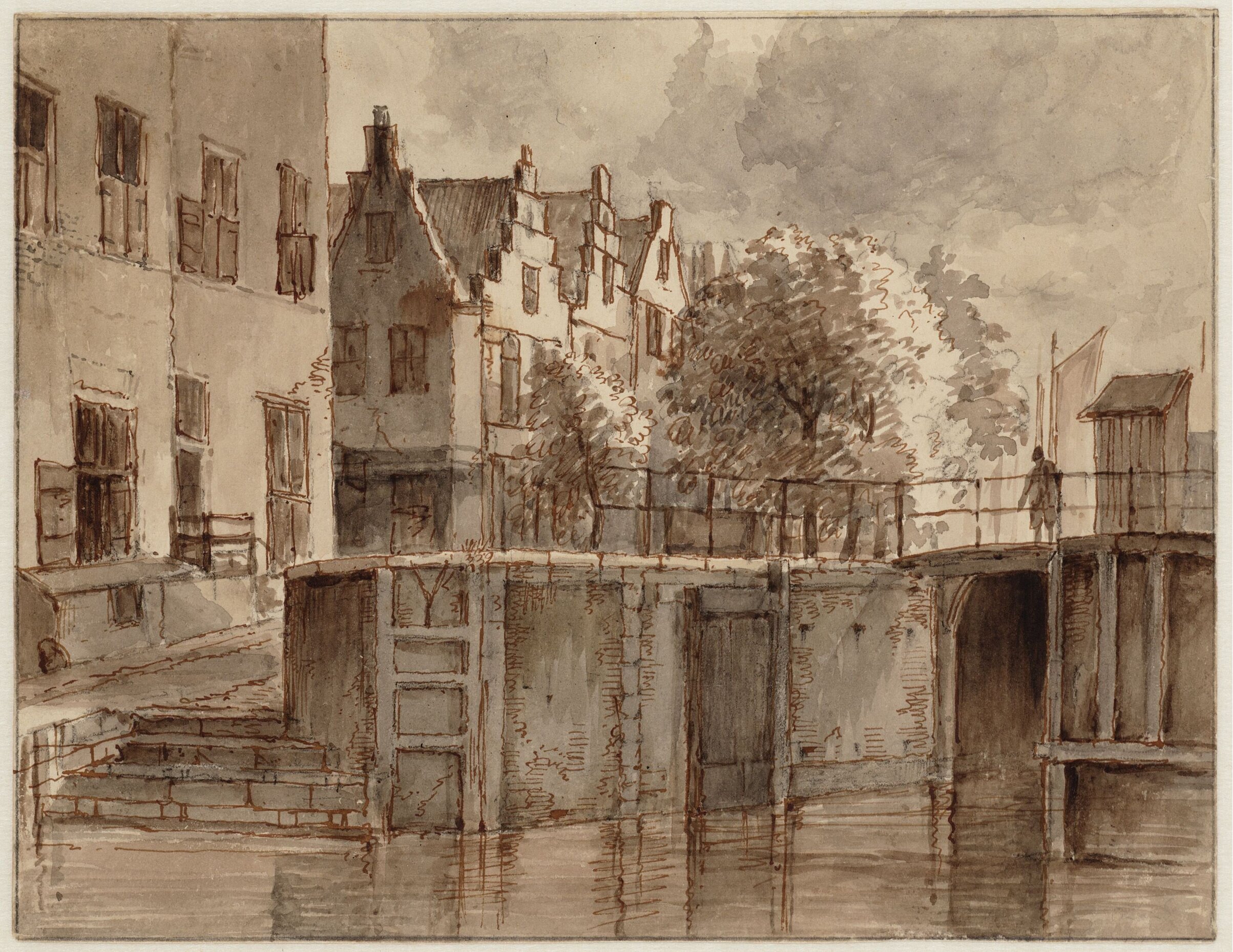
The Old Haarlemmer locks. This is now the paved-over intersection at Martelaarsgracht and Nieuwendijk. Anabaptists gathered in various houses in this part of the city.
More than a century after the fact, the prolific print maker Jan Luyken illustrated a gathering on this boat for the set of 104 etchings that he made for the 2nd edition of Thieleman Jansz. van Braght’s Martyrs Mirror (1685). One young man is shown pointing to his right. Has he spotted the authorities? The man next to him is aware of his gesture while the others continue to reflect on the scripture amongst themselves. As the account indicates, the ferryman was captured and burned at the stake in Amsterdam on 26 February 1569. He had held more than one of these gatherings on his boat and refrained from having his newly born infant baptized.
Stories about Anabaptist martyrs circulated first as songs or letters; later, these were published in small hand-sized volumes that would still be easy to hide. In the Dutch Republic years, with the onset of more tolerant policies toward minorities, much larger tomes of these stories were produced. Several Dutch Mennonite churches, including Amsterdam’s Singelkerk, place either the 1660 or 1685 edition on a table near the front of the church for each Sunday service. German and English translations used by the wider Mennonite community also remain in press around the world to this day. The book offers a material reminder of ephemeral early heritage.
Martyrs Mirror
This is the colloquial name given to a volume of Mennonite martyr stories which was published in 1660 and then published again in a second illustrated edition in 1685. These volumes are the most extensive and well-known today, but they are based on a much longer Mennonite martyrology publication tradition. The sixteenth-century stories were first circulated as songs or letters and later as published volumes - each larger than the last. Execution of Anabaptists in the Netherlands began almost immediately after the establishment of the movement in 1530. Persecution intensified in 1535, after the whole movement was tarnished with a bad name in the wake of riotous activities of some revolutionary groups in the Low Countries and the Westphalian city of Munster.
Martyrs
Those who have sacrificed their lives for the sake of their religion or principles.
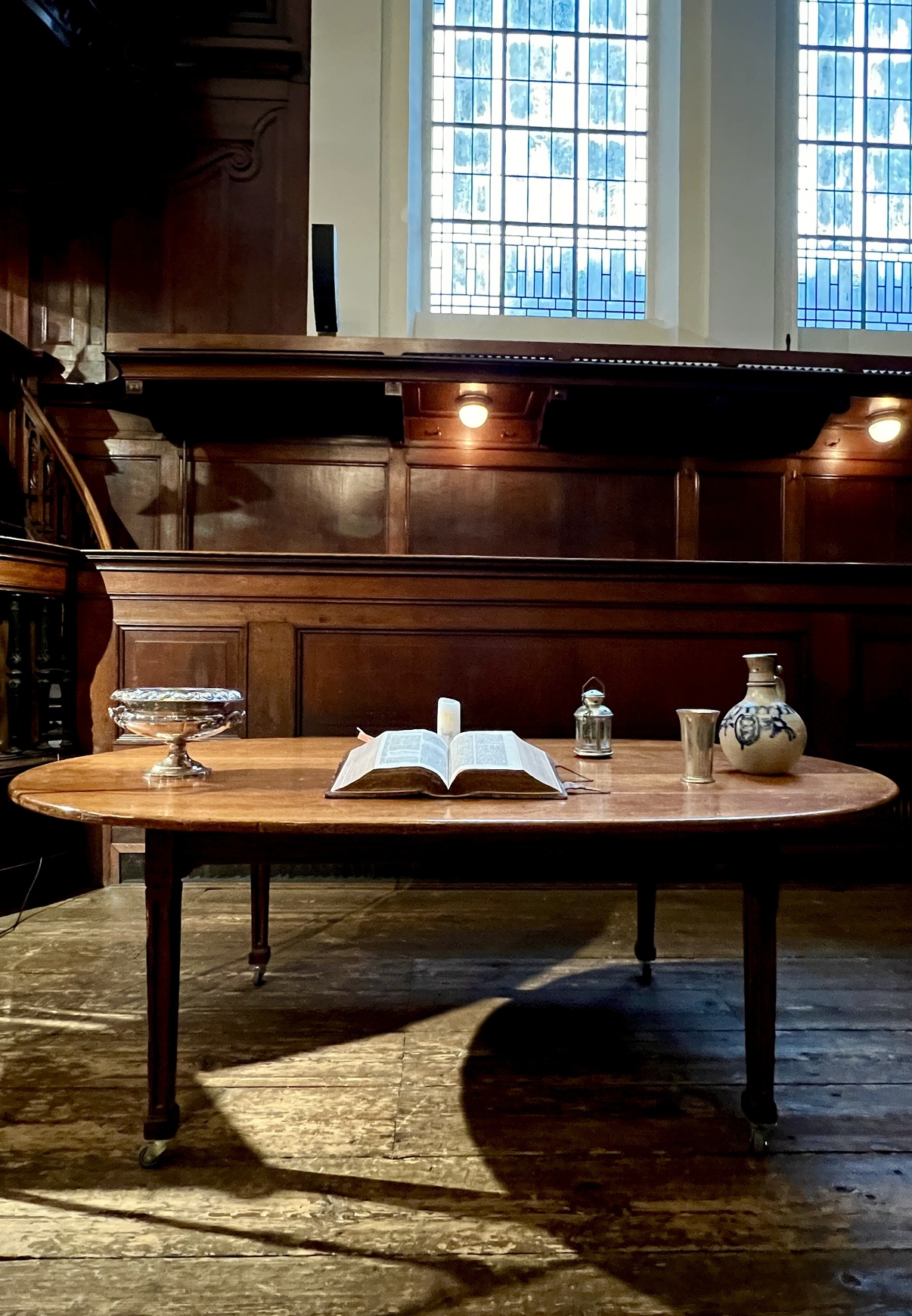
A 1660 edition of the Martyrs Mirror is placed open on a table at the front of the Singelkerk in Amsterdam during each Sunday service.
Nina Schroeder-van 't Schip
Art Historian & Mennonite Heritage Specialist Doopsgezind Amsterdam
Last edited
October 29, 2024
Anabaptists read scripture in the boat of Pieter Pietersz. Bekjen, Jan Luyken, etching, in Thieleman Jansz. van Braght, Martyrs Mirror (1685), part II, 385. Rijksmuseum Amsterdam.
The Old Haarlemmer locks, 1838, George Pieter Westenberg, drawing. Collection Van Eeghen. Stadsarchief Amsterdam.
A 1660 edition of the Martyrs Mirror placed on a table at the Singelkerk in Amsterdam, 2024. Photographer Nina Schroeder-van 't Schip.
Schroeder-van ’t Schip, N., “Mixed Messages: Anabaptist ‘Uproar’ and Mennonite ‘Defenselessness’ in early modern Dutch Visual Culture” in: F. Enns, N. Schroeder-van 't Schip en A. Pacheco eds., A Pilgrimage of Justice and Peace: Global Mennonite Perspectives on Peacebuilding and Nonviolence (Wipf & Stock 2023) 209-237.
Visser, P., “De pelgrimage van Jan Luyken door de doopsgezinde boekenwereld” in: Doopsgezinde Bijdragen 25 (1999) 167-179.
Weaver-Zercher, D. L., Martyrs Mirror: A Social History (Baltimore: John Hopkins University Press 2016).