

 Christianity Protestant
“We are not only victims of our history, we must take initiative to shape our future together.”
Location
Geredja Gunung Batu - Moluccan Evangelical Church Amsterdam
Jacques Perkstraat 1
Type
Church
Religious community
Moluccan Evangelical Church Amsterdam
Object
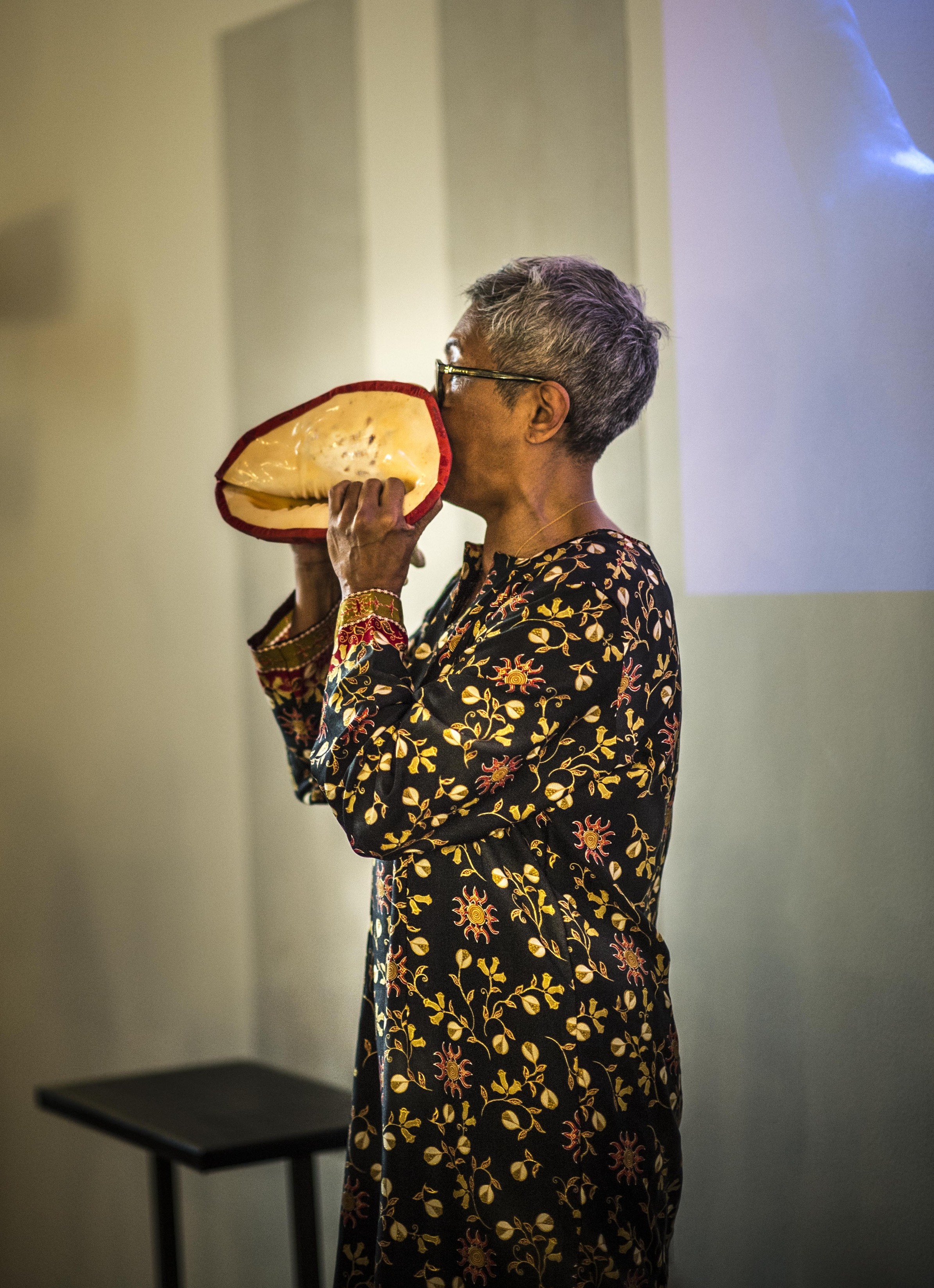
A tan shell with the exterior rim painted red with a size a little larger than a human head that is blown into like a horn and used as a musical instrument.
Visit
During Sunday service in use
Pastor Verry Patty of the Moluccan Evangelical Church saw his parents struggle to fit into Dutch society as first-generation immigrants from the Maluku Islands. “As children we saw the Dutch as our enemies” he recounts. But as a pastor, Verry Patty preaches empathy and the importance of community. He’s happy to see his grandchildren grow up as “children of this world” who are proud of their mixed heritage, “more than Moluccan and Dutch”.
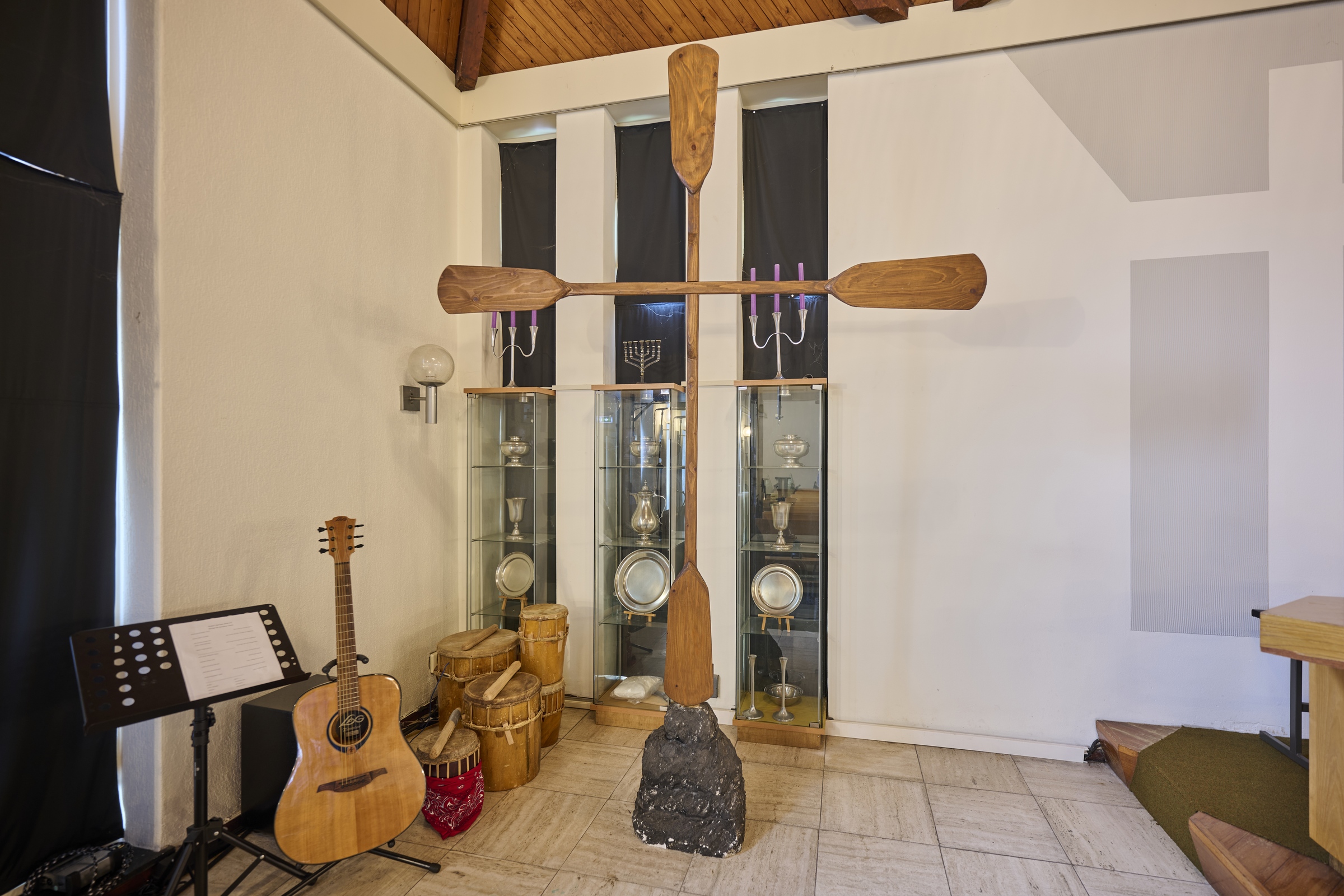
A free-standing cross made from old wooden canoe oars
The Dutch colonized the Maluku Islands for three centuries, bringing Christianity with them in the 16th century. In communities where Protestantism was adopted, local traditions merged with colonial ones. Also today we find examples of this connection. A Tahuri and a cross made of old canoe oars are found in the church of the Moluccan Evangelical Church, representing the congregation’s pride in their shared cultural identity. The Tahuri, a traditional Moluccan shell instrument, is sounded to begin the church service each Sunday, and the oar cross stands tall in the church.
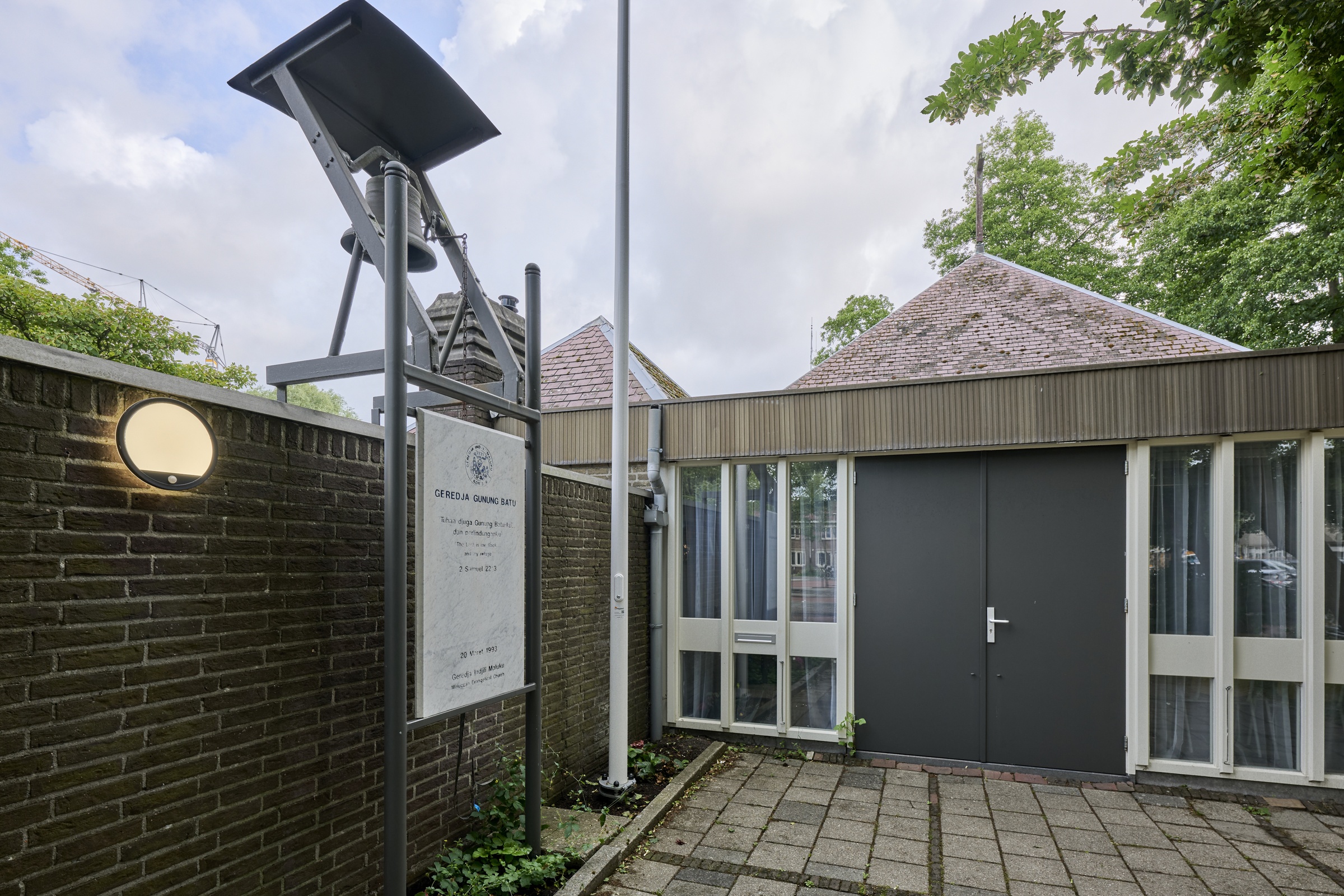
Bell tower placed at the time the church was taken into use by the Moluccan community in 2009
This cultural pride became necessary because “up to 1983, the Dutch government explicitly denied that there were immigrants in the Netherlands” (Amersfoort & Niekerk 2006), denying thus also the existence of tens of thousands of Moluccan immigrants. The Tahuri and oar cross today represent the co-creation of religious belief and practice between “the native country and the land of the settlement...joining the familiar with the unfamiliar”(Padilla & Phan 2016). As fifth and sixth generation Dutch-Moluccans grow, this connection to the islands remains imperative so that the Moluccans’ history is not forgotten.
Pastor Patty sums it up best,
“You have to be proud of your history, the story of your people. History repeats itself but also challenges you to show that you can make a difference.”
Alex Schweitzer Kroll
Student BA module Religious History of Amsterdam: Past and Present, (Vrije Universiteit), 2025
Last edited
September 05, 2025
Tahuri shell, shell, 15 x 8 cm. Photography Carel Schutte
Interior Church. Photography Robert Westera
Exterior Church. Photography Robert Westera
Cross made of old wooden canoe oars, Tom Polnaija, wood, 250 x 100 cm. Church interior. Photography Robert Westera
Bell tower, maker unknown, metal, approx. 400 x 125 cm. Photography Robert Westera
Dandirwalu, R., & Rehy, H. Y. (2020). Tahuri: Symbol of the Christian-Muslim Community Peace in Tehoru and Telutih, Central Maluku, Indonesia. Wawasan Jurnal Ilmiah Agama Dan Sosial Budaya, 5(1), 67–76. https://doi.org/10.15575/jw.v5i1.8071.
Manuhutu, W. (1991). Moluccans in the Netherlands: a Politial Minority?, In L’emigration politique en Europe aux XIXe et XXe siecles. Actes du colloque de Rome (3-5 mars 1988) Rome, Ecole Francaise de Rome, 146(1), 497-511,
Online sources
Christianities in Migration
Last visited 05-09-2025
Immigration as a Colonial Inheritance: Post-Colonial Immigrants in the Netherlands, 1945-2002
Last visited 05-09-2025